Showing posts with label hair products. Show all posts

Saturday, 17 September 2011

Creating products - an overview

I've had a few days to lie in bed and think about what I could be doing if I wasn't ill, and I got to thinking about lotions. I think I can break the lotion making process into six stages - choosing the recipe, assembling and weighing the ingredients, heating and holding the ingredients, combining the two phases, adding the cool down ingredients, and choosing my packaging. I thought I'd spend a few days going over each of these steps, adding links and encouraging you to share your thoughts in the comment section.

As a note, when it comes to other products - say, a shampoo - you'd still work through all those phases, but you wouldn't be concerned with something like emulsification. 

Join me in a few minutes for step 1 - choosing your recipe!

Links to the posts in this series...

Choosing your recipe! 

Thursday, 11 August 2011

The great conditioner experiment: Results!

In June, I decided to undertake the great conditioner experiment to see just how much conditioner my hair might really need! (Click here for more information, although I'll summarize it below!) I've got below-my-waist length, coarse, oily, prone to frizzy hair, but other than the period of time where I went pink (look to your left), I don't dye, perm, or heat style my hair, so it should be in fairly good condition.

I made up a batch of my favourite conditioner, and I've been diluting it every other week or so to see how much water I can use in the product!

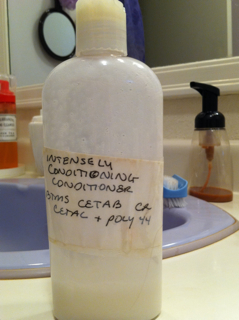
INTENSE CONDITIONER WITH A TON OF CATIONIC INGREDIENTS FOR REALLY DAMAGED HAIR

HEATED WATER PHASE
73.5% water
2% hydrolyzed protein
2% cetrimonium chloride

HEATED OIL PHASE
7% Incroquat BTMS
3% Incroquat CR
4% cetrimonium bromide
4% ethylhexyl palmitate

COOL DOWN PHASE
2% panthenol
2% dimethicone
2% cyclomethicone
2% cationic polymer
1% fragrance or essential oil
0.5% to 1% preservative

Experiment one: I added 50 grams of distilled water with 0.25 grams of liquid Germall Plus to 100 grams of product, which I used for 7 washings, using about 25 grams of conditioner per washing. My hair felt soft, shiny, defrizzed, and detangled. It's very watery, so I've taken to just squishing the bottle over my head and running it through my hair with my fingers, with an extra amount on the ends. I've managed to get three days between washings, so that's a fine thing indeed! (This was before the heat of the summer, as a note! That is relevant!)

Experiment two: I added 75 grams of distilled water with 0.37 grams of liquid Germall Plus to 100 grams of product. I used that for about 9 washings (I think it was 9 - I wrote it down, but someone threw the Post-It note out before I finished with it). I'm finding my hair is soft and shiny, but a little more fly-away than I would like. I'm not that worried about the frizzies right now, and I'm getting two to three days between washings. I would like three, but I don't think that's possible during the summer!

Experiment three: I added 100 grams of distilled water with 0.5 grams of liquid Germall Plus to 100 grams of product. I really don't like this - my hair doesn't really feel conditioned and I find I have to struggle to get the knots out (which defeats the purpose). I think this would make a really great leave-in product, but it doesn't work as a rinse off conditioner. I used this twice, then gave up.

So far, my favourite is experiment 1 with experiment 2 coming in second, although I did need to use a little more anti-frizz spray those days. Experiment 3 was a bust, and I'll reserve that for my leave in conditioning needs. The summer isn't a good time for me to experiment with my hair because I tend to be greasier because of all the sweating and being outside and things. (Cleaning the gutters the other day with the pressure washer wasn't exactly good for my hair, unless a moss and lichen soak is the new salon treatment I haven't heard about!)

How do I modify the conditioner recipe so I can make it as the experiment 1 or 2 version next time? Join me tomorrow for more detail on that question!

Sunday, 17 July 2011

Question: Why would I suggest using silicones for the co-washing method?

Anonymous asked this interesting question about co-washing or the no shampoo method in this postI happen to come across your intesting post regarding cleansing conditioner. I am currently starting the co-wash method however I sometime use products with silicones. So my questions is if I am trying to remove silicones build up then why use a silicone based conditioner like the one mentioned. (Neutrogena triple moisture daily deep conditioner) that is chock full of silicones? Wouldn't that defeat the purposes of removing silicone build up? Please explain as I am trying to educate myself on ingredients that matter so I won't make the mistake of spending money on a so called "Cleansing Conditioner" that would be pretty much the same thing as a regular condtioner that I can in my local grocery.

I've said it before and I'll say it again here, I don't know much about this method. I get the chemistry behind using just conditioners to cleanse one's hair, but I don't get the rules and regulations that seem to come with the various theories or methods. There are tons of ingredients that can cause build up, but it seems the ones to avoid are oils and silicones, or cationic polymers or cationic guar or other conditioning agents. Or maybe not. I simply don't know. For every person who asks me to justify suggesting the use of silicones for this method, someone else writes to me to tell me they love silicones. For every person who avoids oils, others swear by them. So it's really about the philosophy to which you plan to adhere, and learning more about that specific program.

So how does a cleansing conditioner differ from a normal conditioner? It doesn't. For the most part, the cleansing conditioner contains the same ingredients as a normal conditioner, although I've seen a few with very low levels of foaming surfactants like cocamidopropyl betaine. I have noticed that most of the conditioners with the word "cleansing" in the title tend to stay away from silicones (although the Wen conditioner I mention below doesn't), but that might be because those I've seen also bill themselves as natural or organic. I've also noticed that a lot of them contain mint, perhaps for the tingly feeling it can leave behind? (Click here for the longer post on duplicating cleansing conditioners.)


If you can't have silicones, then get a conditioner without silicones or make your own. If you can't have oils, then avoid anything that contains oils, butters, fatty alcohols, fatty acids, and so on (or perhaps it's just normal oils - this is one area that really confuses me). You're trying an approach that requires you to do a lot of work learning and experimenting and generally spending a lot of time and energy on figuring out what your hair likes and doesn't like, and the only way you can learn more about it is to read a lot and experiment a lot. Keep really accurate notes about the various ingredients and what impact they've had on your hair. If you want to avoid something like silicones or cationic polymers, then you'll have to spend the time learning what they are, how they show up in our conditioners, and which ones can create build up (and if they do, how to remove it). I'm afraid I can't offer a one sentence answer or a rhyming couplet to remember what you can and can't have as every person is different. 

If you take a look at the post in which you made the comment, I take a look at two conditioners. One calls itself a cleansing conditioner and the other doesn't. One is expensive and one is reasonably priced. Both contain silicones. I don't actually recommend either of them - I don't recommend commercial products, I recommend making your own! - but use them as tools to explain why both would be suitable as a co-washing conditioner. 

If you are interested in this method, want to know more about how shampoo works on our hair, or just feel like reading more today, here are a few suggested posts...
How does shampoo clean our hair?
How does the no shampoo concept work?
Is shampooing necessary for our hair?
What is build up?
Duplicating the Curl Junkie Daily Fix Cleansing Conditioner

If you're on the Dish forum, then you know I'm leading a crusade to stop the shortening of shampoo to 'poo for what I think are really obvious reasons. I implore you to write those four little letters to make something we wash our hair with sound icky! 

Friday, 10 June 2011

The great conditioner experiment

As you might know by now, my husband and I have long hair (and if you didn't know, you can tell by the picture to your left), which was one of the reasons I started making my own products. We both have very oily hair, and I couldn't find anything but oily roots, dry ends type products that left us feeling slightly greasy even when we washed that morning.

I love my shampoo bar for oily hair, and I love the conditioner bar, but this time of year I find a need a little more conditioning in the form of my intense liquid conditioner with all the swimming, sun exposure, and running around I'm doing. But when I add more conditioner to my hair, it gets greasier quicker. (Click here for more information on how much conditioner to use and how long to leave it in!) So I thought I'd try a little experiment to see how much conditioner my hair really needs!

INTENSE CONDITIONER WITH A TON OF CATIONIC INGREDIENTS FOR REALLY DAMAGED HAIR

HEATED WATER PHASE
73.5% water
2% hydrolyzed protein
2% cetrimonium chloride

HEATED OIL PHASE
7% Incroquat BTMS
3% Incroquat CR
4% cetrimonium bromide
4% ethylhexyl palmitate

COOL DOWN PHASE
2% panthenol
2% dimethicone
2% cyclomethicone
2% cationic polymer
1% fragrance or essential oil
0.5% to 1% preservative


I'm diluting my conditioner and making notes of how my hair feels!

Experiment one: I added 50 grams of distilled water with 0.25 grams of liquid Germall Plus to 100 grams of product (distilled water!!!) and I've used that for three washings so far with about 3 washings left. Which means I'm using about 25 grams of conditioner per wash. I'm happy with this so far. My hair is soft, shiny, defrizzed, and detangled. It's very watery, so I've taken to just squishing the bottle over my head and running it through my hair with my fingers, with an extra amount on the ends. I've managed to get three days between washings, so that's a fine thing indeed!

If I wanted to keep this version the way it is and wanted to figure out the percentages, I would divide every ingredient by 150 and get the percentage that way. So this version has 4.67% BTMS, 2% Incroquat CR, and 2.67% cetrimonium bromide and ethylhexyl palmitate respectively.

Next experiment, adding 75 grams of distilled water and 0.37 grams of preservative to the product and seeing how that works!

Saturday, 21 May 2011

Duplicating products: Curl Junkie Daily Fix Cleansing Conditioner (part three)

So we've taken a look at what makes a cleansing conditioner cleansing, the ingredient list for the Curl Junkie product, and a possible duplicate. Now let's take a look at some other ways we could duplicate this product!

I suggested this recipe as a possible duplication yesterday...


POSSIBLE DUPLICATION OF THE CURL JUNKIE DAILY FIX CLEANSING CONDITIONER WITH CATIONIC GUAR AND OAT FLOUR (VERSION 1.0)
HEATED WATER PHASE
0.25% cationic guar
0.25% hydrolyzed oat flour
80.5% water (replace with hydrosols of choice)
2% cocamidopropyl betaine
2% PEG-7 olivate

HEATED OIL PHASE
7% BTMS-50
3.5% cetearyl alcohol
2% cetrimonium chloride

COOL DOWN PHASE
0.5% powdered extract of choice
0.5% to 1% preservative
1% fragrance or essential oil

...but I'd like to suggest a few alternatives.

If you don't have or like cationic guar or hydrolyzed oat flour, may I suggest using up to 2% cationic polymers for the cationic guar (polyquat 10 or polyquat 44 are the most easily removed from our hair, and both can be used at up to 0.5% in our products), and using one of the hydrolyzed proteins at up to 2% in the heated water phase. If you increase one of your ingredients, remove the same amount from the water in the heated water phase. (Honeyquat's a nice ingredient at 3% in the cool down phase as it offers conditioning and behaves as a humectant!)

If you want to use this as a regular conditioner, not a cleansing conditioner, the one change I'd suggest would be to remove the cocamidopropyl betaine and increase your water by 2%. (Although I really don't think you'd notice 2% cocamidopropyl betaine in this product all that much, why add something that isn't necessary?)

If you want to use cetrimonium bromide, feel free to substitute it for the BTMS-25 or BTMS-50 in this product. You could also add it about 3% or so to the product and remove 3% from the water amount.

If you don't have PEG-7 olivate, you can substitute another water soluble oil - water soluble shea is very nice, as is water soluble aloe oil, but any one will do - or you could just add some oils you like. The BTMS-50 will emulsify any oils you add to this product, so you could use something like sunflower oil, avocado oil, sea buckthorn oil, or even coconut oil (which should be our first choice for hair care products as it's inexpensive and very effective).

If you want some humectant or film formers in the product, add a hydrosol, witch hazel, or aloe vera to the mix. Start at 10% (remove 10% from the water amount) and see if you like it. I'm actually surprised there aren't any humectants in this product as most of the people I've met who co-wash or go no-poo have dry hair, and dry hair loves it some humectants! 3% glycerin, 10% aloe vera, propylene glycol or another glycol, silk protein, and panthenol are all great ingredients for dry hair to increase the moisturization levels of your hair!

So there are a few ideas for how to modify this conditioner - or, indeed, any conditioner! There isn't anything special about this conditioner in its abilities to clean your hair and there isn't a specific reason I chose this one to focus on for a few days, just that it seemed like it was basic enough to put up with a little tweaking!

When you're duplicating your products, keep in mind which ingredients can substitute for other ones. If you don't have hydrolyzed oat flour, use hydrolyzed oat protein. If you don't have that, consider another hydrolyzed protein like wheat, soy, silk, and corn as an option. You aren't limited to those ingredients in the recipe or on the label. And when you learn which ingredients do what, you can go wild with substitutions!

Join me tomorrow for more formulating fun!

Friday, 20 May 2011

Duplicating products: Curl Junkie Daily Fix Cleansing Conditioner (part two)

So what do we need to include in a duplicate recipe for this product? Take a look at the ingredient list again - Water, Cetyl Alcohol, Cetearyl Alcohol, Behentrimonium Methosulfate, Cetrimonium Chloride, Cocamidopropyl Betaine, PEG -7 Olivate, Guar Hydroxypropytrimonium Chloride, Tetrasodium EDTA, Hydrolyzed Oat Flour, Mentha Piperita (Pepperment) Leaf Extract, Matricaria Recuitita (Chamomile) Flower Extract, Yucca Leaf Extract, Urtica Dioica (Nettle) Leaf Extract, Melissa Officinalis (Melissa) Leaf Extract, Polysorbate 60, Equisetum Arvense (Horsetail) Leaf Extract, Tocopheryl Acetate, Phenoxyethanol, Caprylyl Glycol, Fragrance.

I consider the essential ingredients to be water, cetyl alcohol, cetearyl alcohol, behentrimonium methosulfate, cetrimonium chloride, cocamidopropyl betaine, PEG-7 olivate, guar (or another cationic polymer), hydrolyzed oat flour (or hydrolyzed protein), and preservative. (You don't really need to include the Vitamin E as none of the ingredients have short shelf lives and the polysorbate 60 is an emulsifier. We already have the BTMS-25 or BTMS-50 as an emulsifier here, so it's kinda pointless to include it. It was probably part of another ingredient, possibly the extracts, so we don't need to include it here!)

Oh, and as a note, if you don't include the cetrimonium chloride in this product, you'll have a thicker product. There will be a few notes about this at the bottom of the post.

POSSIBLE DUPLICATION OF THE CURL JUNKIE DAILY FIX CLEANSING CONDITIONER WITH CATIONIC GUAR AND OAT FLOUR (VERSION 1.0)
HEATED WATER PHASE
0.25% cationic guar
0.25% hydrolyzed oat flour
80.5% water (replace with hydrosols of choice)
2% cocamidopropyl betaine
2% PEG-7 olivate

HEATED OIL PHASE
7% BTMS-50
3.5% cetearyl alcohol
2% cetrimonium chloride

COOL DOWN PHASE
0.5% powdered extract of choice
0.5% to 1% preservative
1% fragrance or essential oil

Hydrate the oat flour and cationic guar in room temperature water for at least one hour before the time you might be using it in the product. (I wouldn't use all the water phase for this because you'll want some for the product! Use maybe 20% or so.)

Weigh the water phase and put into a double boiler. Weigh the oil phase and put into a double boiler. Heat and hold both for 20 minutes at 70˚C or 158˚F. Remove from the heat and combine the two phases. When the mixture reaches 50˚C or 120˚F, add the water with the cationic guar and oat flour to the product and mix well. Add the cool down phase at 45˚C or lower. Use and rejoice.

This should give you a medium viscosity product.

A note on this recipe: If you're using BTMS-25, you can substitute it directly for the BTMS-50, but use cetyl alcohol at 50% of the BTMS-25 amount. THIS ONLY APPLIES TO THESE RECIPES as we aren't looking to the BTMS to emulsify anything! If you are looking to emulsify any amount of oils or silicones, you need to use BTMS-50 instead.


Another note on this recipe: If you're not using cetrimonium chloride, reduce the amount of BTMS-50 or BTMS-25 to 4% and the fatty alcohol to 2%. Cetrimonium chloride thins out our recipes, so a 7% BTMS-50 recipe without cetrimonium chloride will be very very thick. 


I know I'm trying to duplicate the product and the fatty alcohols come before the behentrimonium methosulfate in the recipe, so I should be putting more fatty alcohols into the product than BTMS, right?

When you consider that if we are using 7% BTMS-25 we should have 25% BTMS (so 1.75% behentrimonium methosulfate and 5.25% cetearyl alcohol), so in that case, we have far more cetearyl alcohol than we do cationic quaternary compound). By adding 3.5% cetyl alcohol a conditioner with BTMS-25, we'd have 5.25% cetearyl alcohol, 3.5% cetyl alcohol, and 1.75% behentrimonium methosulfate. So we do have more fatty alcohols than behentrimonium methosulfate!

If we're using 7% BTMS-50, we'd have 3.5% behentrimonium methosulfate and some percentage of cetyl alcohol and butylene glycol in the product.  If I were to use BTMS-50, I'd have 3.5% behentrimonium methosulfate, 3.5% cetearyl alcohol (added), and less than 3.5% cetyl alcohol (in BTMS-50).

Okay, another thought. If fatty alcohols boost the substantivity of cationic quaternary compounds - add them around 50% of the compound amount - and if these ingredients contain fatty alcohols already, what's the point of adding more fatty alcohol? We've already got enough in the BTMS-25 or BTMS-50 to boost the substantivity! Great point. We're adding the fatty alcohol here as an emollient or moisturizer.

Why is this version one? Because I'm planning a version two! I don't have hydrolyzed oat flour, but I do have hydrolyzed oat protein, and since I'm not that worried about the viscosity of the product (the BTMS and fatty alcohols are great thickeners), I think I'd prefer to use the liquid protein at 2% and leave out the hydrolyzed flour. And cationic guar gum can lead to build up on our hair that should be removed by foamy shampoo type products. If you aren't using a product of that nature, then this probably isn't the best cationic polymer for you. I'm thinking a better choice might be polyquat 44 or honeyquat (click here for information on cationic polymers).

As a final note for this post! This stuff applies to all conditioners you might make, not just a duplicate of this one! The essential component of any conditioner is the cationic quaternary compound. The rest of the ingredients are what makes the product good for oily hair or dry hair or chemically processed hair, and so on.

Join me tomorrow for another possible duplicate version of the Curl Junkie Daily Fix Cleansing Conditioner!

Wednesday, 18 May 2011

Duplicating products: Cleansing conditioners

Before we get into trying to duplicate a few cleansing conditioners, we need to establish what it means for a product to be a cleansing conditioner versus a normal conditioner. (For a quick summary of the no-shampoo method or co-washing method, click here.)

How does a cleansing conditioner differ from a normal conditioner? It doesn't. For the most part, the cleansing conditioner contains the same ingredients as a normal conditioner, although I've seen a few with very low levels of foaming surfactants like cocamidopropyl betaine. I have noticed that most of the conditioners with the word "cleansing" in the title tend to stay away from silicones, but that might be because those I've seen also bill themselves as natural or organic. I've also noticed that a lot of them contain mint, perhaps for the tingly feeling it can leave behind?

Please note that I don't adhere to the no-poo method and I don't know much about it. I'm not here to debate the merits of the method and whether it works or not. I'm just sharing information I've learned about the concept. 

If we take a look at something like the Wen Mint Sweet Almond Cleansing Conditioner (I've analyzed this product in more detail in this post), you'll notice very little difference between it and a product that isn't advertised as being cleansing. All conditioners will contain a cationic quaternary compound like behentrimonium methosulfate, behentrimonium chloride, cetrimonium bromide, stearalkonium chloride, or stearamidopropyl dimethylamine as the primary conditioning agent. Most will contain a fatty alcohol - cetyl, cetearyl, stearyl, or behenyl - to boost the conditioning of the cationic quaternary compound. All will contain some water and preservatives, and some might contain oils or modified oils. Everything else is just icing on the proverbial cake (for instance, panthenol, protein, silicones, fragrance, and so on).

If you want to learn more about what makes a conditioner a conditioner, click here or check out the hair care section of this blog! 

Why do they call it a cleansing conditioner? Because they can. This isn't to say that very dry or African hair types won't benefit from a cleansing conditioner, and this isn't to say a cleansing conditioner isn't a good conditioner, but you can get the same benefits co-washing or going no-'poo with just about any conditioner. (Although some will say to avoid conditioners with silicones because there could be some build up, I'd be more worried about the build up coming from things like polyquats and cationic guar. I wonder if not using heat styling or anti-frizz products is part of the no-poo concept, because those are chock full of silicones? Anyone using this method, can you advise?)

As a note, seriously? We're calling this no-poo? We can't come up with a better name for this process? 

You can make a conditioner with behentrimonium methosulfate, cetyl alcohol, water, and preservative and call it a conditioner or a cleansing conditioner. You can make a conditioner with cetrimonium bromide, cetearyl alcohol, water, preservative, mint essential oil, a bunch of botanical extracts, and coconut oil and call it a conditioner or a cleansing conditioner. Or you could make a conditioner with only behentrimonium methosulfate, water, and preservative, and call it a conditioner or a cleansing conditioner. For the most part, the main difference is the description of the product.

So let's take a look at a few cleansing conditioners and how we can duplicate them! Join me tomorrow for a look at Curl Junkie Daily Fix Cleansing Conditioner!

If you wish to make a suggestion for a product we might like to duplicate, please visit this post and provide an accurate ingredient list and link in a comment. 

Tuesday, 17 May 2011

Duplicating products: Chi Silk Infusion Hair Serum (part 2)

Let's pick up where we left off yesterday with the Chi Silk Infusion Hair Serum. If you want to make a suggestion for a product we might consider duplicating, please make a comment in this post with an accurate ingredient list and link to the product. 

What's with the mica and boron nitride? Think about the refractive index for a minute. When we use ingredients like boron nitride, mica, dimethicone, and so on, we increase our hair's shininess. The problem is that we don't know how much they're using - it's probably a titch - so I'm  leaving those ingredients out of the equation and sticking to the silicones and emollients for my shine. If you want to include boron nitride or mica in your product, make it, then add a little bit and see how you like it. I don't really want the shine of mica in my hair, so I'm not including it in this version.

We have a few problems in trying to replicate this product. First problem: Where can I get dimethiconol? I can't find it anywhere! I found it at Making Cosmetics, but you have to buy a giant pail of it, and I really just want to try it for this product. Second problem: Where can I find the ethyl ester of silk? I need to use this version of silk as this is an oil based product, and the silk I own is water based and will just float to the top of the product and sit there. Third problem: How did they incorporate panthenol, a water based ingredient, into this product? If it's an oil soluble version, where can I find it?

I don't think we can replicate this product, but we can get close-ish. We can't find three of the ingredients, and I think the dimethiconol and the silk are pretty much essential in this product, so this is going to be a problem. We can try our best to make something awesome, so let's give it a go!

As a note, some people would argue that the silk isn't essential to this product for your hair as there probably isn't a lot in there, but I would argue that it's essential for our enjoyment and perception of the product.

Cyclomethicone will be the base of this product, at about 80% to 90% or so. When considering the ester you want to use, you could choose C12-15 alkyl benzoate or ethylhexyl palmitate, which is considered a silicone replacement and offers some nice shine in our hair. The ethylhexyl palmitate is a slightly lighter feeling ester, but that really won't make a huge difference in our hair. We'll be including dimethicone, of course, for the defrizzing and shine. We don't need to include preservative in this product as it is oil based and we won't be introducing water into it but we could include a non-polar fragrance to it (although I wouldn't bother with a product like this as you already have the fragrance from your conditioner and possibly leave in conditioner, so why go through the trouble of figuring out which of your fragrance or essential oils are polar and which are not just to include it in this product?).

So we have three ingredients in this product - cyclomethicone, dimethicone, and our ester (either C12-15 alkyl benzoate or ethylhexyl palmitate). I'm going to base this recipe on my usual anti-frizz spray and replace 5% of the cyclomethicone with 5% ester.

A POSSIBLE BUT NOT REALLY THAT CLOSE TO A DUPLICATION OF CHI SILK INFUSION HAIR SERUM
85% cyclomethicone
10% dimethicone
5% C12-15 alkyl benzoate or ethylhexyl palmitate
(If you have dimethiconol, try using it at 5% to 10% of the cyclomethicone amount.)

I've never tried this Chi Silk Infusion Hair Serum before - those of you who have, can you comment as to how close you feel this is to the original?

Join me tomorrow as we take a look at a few "cleansing" conditioners.

Sunday, 15 May 2011

Duplicating products: Chi Silk Infusion Hair Serum

Mychelle suggested we take a look at the Chi Silk Infusion Hair Serum. (If you'd like to make a suggestion, hie thyself to the duplicating products introductory post, and comment. Please include an accurate ingredient list and a link to the product somewhere on the 'net.)

Shall we take a look at the ingredient list? (Remember to click on the links to learn more about each ingredient as it's just too long here to include every single bit of information!)

Cyclomethicone: A silicone. Generally combined with dimethicone in anti-frizz products, it helps with the spreading abilities (not that dimethicone really needs the help), helps with wet combing, delivers the active ingredients to your hair, then evaporates, which decreases your drying time (which is a good thing for us frizzy haired girls!).

Dimethiconol: It's technically a dimethylsiloxane terminated with hydroxy groups, a gum version of dimethicone with slightly higher viscosity than our normal dimethicone (the dimethicone we find most commonly is about 350cs; the gum is 400 to 500 cs. I have a 1000 cs version of dimethicone from Soapcraft, so there are all kinds of viscosities of this stuff!). It is more effective than dimethicone at reducing dry combing forces.

Dimethicone: A silicone. In hair care, it improves wet and dry combing, helps with shine, improves hair feel (softness), reduces static charge, and works as a humidity resistor. And in colour cosmetics, like foundations, it is a lubricant, spreading agent, emollient, and diluent/carrier ingredient.

C12-15 Alkyl Benzoate: A dry feeling ester that acts as an emollient and fragrance fixative.

Panthenol: Panthenol for hair care products is a fantastic addition at 2% to 5%. It builds a thin moisture film on the surface of your hair (film former) and makes it shine without oil or greasiness. In addition, it can penetrate the cuticle of your hair and brings moisture to the cortex! This means you get good manageability and pliability of your hair, and it is better able to cope with brushing, wind, and other non-hair friendly things. Finally, it could give your hair more body! Studies have shown that 2% left on for 2 minutes can actually swell the hair shaft, making it seem thicker! (So use it up to 5% in your conditioner or leave in conditioner!)

Ethyl Ester of Hydrolyzed Silk: This is like hydrolyzed silk protein, but it's the ethyl ester of the protein. I think this is done to make a water soluble ingredient oil soluble.

It's chemistry time! Hooray! It's my favourite time of the day! (If you want to know more about the chemistry of esters, click here.) From Wikipedia: Esters are chemical compounds derived by reacting an oxoacid with a hydroxyl compound such as an alcohol or phenol. Esters are usually derived from an inorganic acid or organic acid in which at least one -OH (hydroxyl) group is replaced by an -O-alkyl (alkoxy) group, and most commonly from carboxylic acids and alcohols. That is, esters are formed by condensing an acid with an alcohol. Methyl and ethyl esters are commonly available for many amino acids. 

Phenoxyethanol: Preservative. But I'm not really sure why this would be in an all oil product?

Fragrance: Makes it smell pretty!

D&C Yellow 11 and D&C Red 17: Colours.

Zinc Oxide: Not really sure why this is here. It could be used as a whitening ingredient or it could be used as a sunscreen.

Titanium Dioxide: Not really sure why this is here, either. It could be used as a whitening ingredient or it could be used as a sunscreen.

Mica: Probably used as a colouring agent, it might give your hair a little sparkle.

Boron Nitride Powder: This will give your hair a little sparkle, I think.

What do we have here? We have an oil based product that is used for smoothing your hair. It won't offer any serious conditioning to your hair as it doesn't contain any cationic ingredients, but if you've got frizzy hair or use a lot of heated hair appliances, this would be a very good product for you.

I hate to do this, but we'll have to leave this product for now and come back again to it tomorrow. I'm really not feeling all that well this weekend, and I dread to think it's the return of that horrible stomach flu, which is still going around my agency and my town and it's causing me to feel really weak and shaky and horrible! So join me tomorrow as we take a further look at this product!

Saturday, 14 May 2011

Duplicating products: Giovanni Direct Leave In Conditioner

Sweeteababy suggested that we take a look at the Giovanni Direct Leave In Conditioner. (If you'd like to make a suggestion for a product we could duplicate, please click on this link and leave me an accurate ingredient list and a link to the product somewhere on the 'net.)

Let's take a look at each ingredient.

Aqua (Purified Water): Our solvent.

Rosemary (Rosmarinus Officinalis) Oil*, Nettle (Urtica Dioica) Oil, Thyme (Thymus Vulgaris) Oil*, Birch Leaf (Butela Alba) Oil, Chamomile (Anthemis Nobilis Flower) Oil*, Clary (Salvia Sclarea)*, Lavender (Lavandula Angustifolia)*, Coltsfoot Leaf (Tussilago Fargara)*, Yarrow (Achillea Millefolium) Oil*, Horsetail (Equisetum Arvense) Oil*: Please click here for the post on the 50:50 conditioner for more information on these extracts.

Birch Leaf (Butela Alba) Oil: I can't find much about the benefits of this oil for our hair. I found that it is an astringent and helps with blood circulation, but I'm not really sure how the latter works for a conditioner.

Mallow (Malya Sylvestris)*: Mallow contains a lot of mucilage, which can form a moisturizing film on our hair and skin.

Soybean Protein (Glycine Soja)*: A hydrolyzed protein that will offer film forming and moisturization to our skin and hair.

Cetyl Alcohol (Plant Derived): An emollient fatty alcohol that boosts the substantivity of cationic quaternary compounds found in hair conditioners.

Tocopherol (Vitamin E): Our anti-oxidant.

Panthenol: A vitamin that can behave as a humectant and film former. Very good for our hair.

Trace Minerals: No idea what this could mean.

Citric Acid (Corn): pH adjuster.

Sodium Hydroxymethlyglucinate: Preservative - Suttocide A.

Grapefruit Seed (Citrus Derived): Not a preservative, but could be an anti-oxidant.

As a quick note, I went to this website and found the ingredient list also included aloe vera after the water, panthenol after the tocopherol, and phenoxyethanol as a different preservative. This one has almost the same list sweeteababy posted, but it includes the panthenol. I've included panthenol in the ingredient list because it seems like this is the version she has.

What do we have here? I can't tell you what we don't have - we don't have a leave in conditioner. A conditioner must contain a positively charged ingredient like behentrimonium methosulfate (Incroquat BTMS-50), behentrimonium chloride, cetrimonium bromide, cetrimonium chloride, and so on. We don't have that in this product. (Click here for more information on conditioners.) Without a cationic ingredient, we just have a lotion you put into your hair.

But we don't even have that! There is nothing in this ingredient list that would be considered an emulsifier for those oils and the cetyl alcohol, so I'm feeling like there's something missing in the list. We have a ton of essential oils - well, 8 - and if we used those at even 0.5% each, we'd still have 4% oils in this product. Even if there's only 1% cetyl alcohol, we have 5% oils we're adding to this water based product and they'll just float on top of the product being un-emulsified if we don't add something to it that will create an emulsifed product.

So I'm not sure where to go with this product. I can't duplicate it because it doesn't contain an emulsifier or a cationic quaternary compound, and I know if I make it up with this ingredient list, I'm going to end up with a separated mess of oils and water that won't offer anything to my hair because it doesn't contain a conditioner. I've done my searches on line and I can't find a version of an ingredient list that contains an emulsifier and/or cationic ingredient.

What I will do is leave you with this suggestion: Find a leave in conditioner recipe you like - I hope I'm not being arrogant by suggesting this one - and add the extracts at whatever rate you want (I'd suggest 0.25% for each of the essential oils to start, and whatever you want for the water soluble ingredients.) Use BTMS-50 or another cationic ingredient that emulsifies at 2%, cetyl alcohol at 1%, hydrolyzed protein at 1%, panthenol at 1%, vitamin E at 0.5%, and your preservative at 0.5% to whatever the suggested rate might be. Add water to make up to 100%, and you've got yourself a leave in conditioner.

Join me tomorrow for more fun duplicating products!

Friday, 13 May 2011

Duplicating post: Deva Care's Low Poo No Fade Shampoo

I have to start this post off with two points of interest. One, I can't get onto the site for this product, so I have to rely upon Photoshadow's ingredient list (which I'm sure is accurate). I either get a 404 message or a warning that the site isn't safe for my computer. Weird. Two, why do people want to call shampoo "poo"? Are we not aware what this word means in other settings? Is it really so hard to say the syllable sham- that we're willing to use a word that doesn't usually associate well with the idea of being clean. Let's all make the effort to include the sham- part of the word and we'll all be happier for it.

Okay, now that those things are off my chest, on to the ingredient list!

Oh wait, another point of interest! What the heck does "aqueous extract" of something mean? I see it all the time in place of water. It basically means one of two things (and I am generalizing here): The water has had something dissolved into it or the water is a hydrosol or distillate. By definition, if I dissolved the various powdered and liquid extract I used into my water before adding it to the product, I would be using an aqueous extract. So that's what that means! Okay, on to the ingredient list.

Aqueous Extracts...
Achilea Millefolium: Yarrow: Reported to be good for oily hair and skin and might have anti-inflammatory properties. Or it might be good for dry or damaged skin by reducing flaking. This report from 2001 (found in PubMed) found that there wasn't enough evidence that Yarrow was safe, and it is known to cause photosensitivity and irritation. And Cosmetics Info re-iterates this report.

Chamomilla Recutita (Matricaria): Chamomile: A good anti-inflammatory, anti-oxidant, and anti-irritant. Could be an extract or the essential oil as a fragrance.

Cymbopogon Schoenanthus: Also known as camel grass or West Indian lemon grass. An astringent ingredient.

Humulus Lupulus (Hops): Can offer anti-bacterial and anti-inflammatory and soothing properties. Hops have been used in hair care products in beer for quite some time.

Melissa Officinalis (Balm Mint): An astringent ingredient, it has anti-viral and anti-bacterial properties,

Rosmarinus Officinalis (Rosemary): Great for oily hair, it offers a ton of polyphenols and anti-oxidizing properties.

Citrus Aurantium Dulcis (Orange) Peel: This is advertised as keeping the colour in your hair. I'm not really sure how orange peel extract can do that, but it can be good for oily hair.

Cocamidopropyl Betaine: An amphoteric surfactant used as a secondary surfactant to create mildness in our products.

Propylene Glycol: Our humectant, it draws water from the atmosphere to our hair to offer moisturizing (but isn't great for frizzy haired people) and it reduces the temperature at which the product will freeze or reach its cloud point during transit.

PEG-40 Hydrogenated Castor Oil: An ingredient that forms emulsions and helps other things dissolve. Can increase the sensitization potential of other ingredients (according to CosmeticsInfo)

PEG-75 Lanolin: A polyethylene glycol ether of lanolin, it works as a skin emollient and conditioner. It will make your skin and hair feel more moisturized after use. And it can be a secondary emulsifier.

PEG-7 Glyceryl Cocoate: An emollient, emulsifier, and thickener that will increase the viscosity of the product and make it feel more moisturizing.

Benzophenone-4: Used as a sunscreen in products. (Click here for slightly more information.)

Polyquaternium-10: A cationic polymer used to condition our hair and thicken products, it works well in surfactants. It comes as a powder that can be used at 0.25% to 0.5%, but it's okay to go as high as 2% without incurring irritation.

Hydroxyethylcellulose: Our thickener for this product. Very like hydroxypropyl methyl cellulose (HPMC), it's added to our products to make them thicker. Generally used at low levels, like 0.1% to 0.3%.

Polyquaternium-7: A liquid cationic polymer we can add to surfactant mixes at up to 5%.

Diazolidinyl Urea, Sodium Benzoate, Potassium Sorbate: Preservatives.

Ascorbic Acid: Also known as Vitamin C, it can behave as an anti-oxidant.

Fragrance: Smells pretty.

Red 40, Yellow 5: Colours.

Before you move on, ask yourself this question - what makes this low foaming? What makes this product safe for coloured hair? (The point of these posts is to help you learn to formulate, so this is an important question.)

The answer for both questions is the same - the low level of incredibly mild - gentle, even - surfactants in the product. The only foaming surfactant is the cocamidopropyl betaine, which we would normally use as a secondary surfactant to increase mildness. It's a very very gentle cleanser. We also see mildness enhancers like PEG-7 glyceryl cocoate, which is technically a surfactant, but not a lathery one. We see lots of emollients in here - the PEG-7 glyceryl cocoate and PEG-75 lanolin - both of which might interfere with the foam (which isn't that much to start off with!).

There isn't anything inherently colour protecting in this product. We make our products more colour protecting by ensuring we have a good pH level, that we aren't using harsh detergents, and we are using low levels of gentle and mild surfactants. The extracts are good for our hair and scalp - especially if you have oily hair as there are tons of astringent ingredients - but they aren't necessary for making a good product. Think of them as icing on the proverbial cake: Cake is awesome without icing, but it's even better with a little flower or heart on top.

Where do you think the 1% range starts? I think it's with the sunscreen, but a lot of these extracts will be used at 0.5% or lower, but are included at the top because they're being used in the water, which makes up the bulk of the product.

How would we make this product? We know the cocamidopropyl betaine will be used at low levels - maybe 10% to 20% - and the water will make up most of the product. I'm thinking about the propylene glycol at 3% or so (use glycerin if you don't like this ingredient), and the two cationic polymers at 0.5% each. I'm going to include PEG-7 glyceryl cocoate at 1%, and I think I'll use a water soluble emollient like water soluble shea or olive oil (as I don't have PEG-75 lanolin and don't know where to get it) at 1%. The fragrance will be around 1%, and I'll definitely need a thickener.

For the extracts, I don't know where to get yarrow, hops, or West Indian lemon grass, so I'll leave those out. I could use a hydrosol for the chamomile, melissa, rosemary, and orange (I have neroli hydorosol), use an essential oil for all three, or use a powdered extract for the rosemary and chamomile, a hydrosol for the orange, and an essential oil for the melissa or chamomile. It's really up to you on how you choose to combine these. Since chamomile essential oil is really expensive and since I hate the smell, I'll go with the hydrosol for this and the rosemary. I don't like the smell of melissa either, but I could use it in combination with orange essential oil at about 0.5% of each.

We have a grand total of 17.5% ingredients and 82.5% water here. I'm going to be using hydrosols for the water (I'm thinking 20% chamomile hydrosol and 20% rosemary hydrosols) and 1% in powdered extracts, so I need to use 40% water. The remaining 2.5% will be the thickener. You can use the hydroethyl cellulose, but I'm using Crothix because I'm not the biggest fan of using cellulose in my products. I have to wait for it to hydrate then add it in and it always seem to feel a bit...well...I'll use the words gooey and stringy without having to resort to references to mucous.

Let's take a look at a possible recipe for this product...

POSSIBLE DUPLICATION OF DEVA CARE'S LOW POO NO FADE SHAMPOO
HEATED WATER PHASE
20% chamomile hydrosol
20% rosemary hydrosol
40% water
10% cocamidopropyl betaine
3% propylene glycol or glycerin
1% water soluble oil
1% PEG-7 glyceryl cocoate
0.5% polyquat 7
0.5% polyquat 10

COOL DOWN PHASE
0.5% preservative
1% essential oil
2.5% liquid thickener like Crothix (optional, and don't add it in before the product cools)

Heat the heated water phase to 70˚C and hold for 20 minutes. Remove from the heat, let the product cool to around 45˚C, then add the cool down phase. Wait for it to come to room temperature before changing the viscosity. This is going to be a very very very thin product, so you'll definitely have to thicken it, but we don't want to add too much. Use the liquid Crothix at 0.5% at a time and mix well before adding another 0.5%.

Join me tomorrow for more fun duplicating products!

Monday, 2 May 2011

Duplicating products: Ojon Revitalizing 2 Minute Hair Mask

Ingrid made the suggestion in this post that we try duplicating the Ojon Revitalizing 2 Minute Hair Mask. (If you want to make a suggestion for a product we could duplicate, please click here and leave a comment with the ingredient list and a link to the product.) So let's take a look at the ingredients...(And please click on the links if you want to know more about each ingredient!)

Water: Our solvent.

Cetearyl alcohol: A fatty alcohol that will help boost the substantivity of the cationic quaternary compound.

Behentrimonium chloride: Like behentrimonium methosulfate (Incroquat BTMS-50) but with chloride instead of methosulfate. This is our conditioning agent and emulsifier, and is essential for this product. We can moisturize our hair as much as we want, but without the conditioning agent we don't have a conditioner. We really need this ingredient as an emulsifier for all these oils!

Palm oil: A very thick oil, almost like a butter, that is very moisturizing for hair and skin.

Orbignya speciosa kernel oil or curua palm oil: Another type of palm tree from South America that produces an oil very similar "in colour and odour to palm kernel oil". It has a lower melting point than palm kernel oil, though.

Palm kernel oil: A very thick oil, almost like a butter, that is very moisturizing.

Safflower seed oil: Very similar to sunflower oil, it's high in linoleic acid, which is very moisturizing.

Meadowfoam seed oil: A very long shelf life oil (about 2 years) with tons of anti-oxidants and strange new fatty acids.

Sunflower seed oil: A light feeling oil with a 6 month to 1 year shelf life, it offers high levels of linoleic acid and Vitamin E.

Macadamia nut oil: A light to medium dry feeling oil with a 1 year shelf life that contains a ton of phytosterols.

Sesame oil: A medium feeling oil with a nice balance of linoleic and oleic acids. It has a shelf life of about a year.

Babassu oil: A dry feeling solid oil that melts at skin temperature. It has a shelf life of about 1 year.

Olive oil: A medium to heavy weight greasy feeling oil with a shelf life of about a year.

Unsaponifiables: Unsaponifiable matter is that matter which is present after an oil has been saponified or mixed with a base like sodium hydroxide or potassium hydroxide. That which is left over includes lipids of natural origin - tocopherols, squalene, and phytosterols (which help soften our hair and reduce static charge). Unfortunately, there's no information about what unsaponifiables these might be and what they might contain, so there's nothing we can really do about this ingredient.

Jojoba seed oil: Not really an oil but a liquid wax, it can penetrate through the hair follicle to offer moisturizing. It has a shelf life of up to 2 years.

Avocado oil: A heavy weight oil with a shelf life of about a year. It's easily absorbed by the skin and hair, which is why you'll see it in hair care products - it softens and conditions, and protects against fly away hair.

Sweet almond oil: A light weight oil with a 6 month to 1 year shelf life. It contains a lot of oleic acid, which can be softening and moisturizing.

Passion fruit seed oil: Also known as maracuja oil, it's a light weight oil with a shelf life of about a year. It's high in linoleic acid (77%) and it is supposed to be rich in Vitamin C, calcium, phosphorus, and anti-oxidants (it would have to be to last a year with that much linoleic acid!). I've seen it written that it "encourages healthy hair growth and increased vitality". Nothing can make your hair grow, so I doubt that's accurate.

Coffee seed oil: Derived from coffee seeds, it has the strong smell of coffee and is reported to contain anti-oxidants (I couldn't find any really good information on this oil). It is suggested for use at 3% to 10%.

Murumuru butter: Very much like coconut oil - and it can be substituted for it - it contains a lot of lauric acid, which is a fantastic fatty acid for hair as it has a high affinity for proteins. Because of its low molecular weight and linear chain structure, it can actually penetrate the hair shaft.

Shea butter: A greasy feeling butter with a shelf life of two years.

Mango butter: A drier feeling butter with a shelf life of two years.

Rosemary leaf extract: Could be an essential oil, could be an anti-oxidant.

Hydrolyzed rice protein: A hydrolyzed protein like silk or oat, it will film form and offer moisturizing to our hair.

PEG-100 stearate: A high HLB emulsifier used in combination with a low HLB emulsifier to create an emulsification system.

Glyceryl stearate SE: A complete emulsifier, unlike glyceryl stearate (not SE).

Fragrance: Smells pretty!

Hydroxycitronellal: A synthetic Mugeut or lily of the valley fragrance. (Click here for more information.)

Magnesium nitrate: Used as a dessicant to keep water out of products. (Click here for more information.)

Methylchloroisothiaxolinone: Preservative with anti-bacterial and anti-fungal properties.

Methylisothiazolinone: Preservative (read more about it here - very interesting studies!)

Okay, so what do we have here? We have what should be a very thick conditioner with tons of emollients, a cationic quaternary compound (our conditioner), and some emulsifiers. Are the emulsifiers necessary in this product? Can't we just use our BTMS-50 as an emulsifier? Yes, you can, depending upon how much you use.

Where do you think the 1% phase starts? I think it starts with the rosemary leaf extract, but it could be anywhere on the list below the hydroxycitronellal, because fragrances are generally at 1% or lower.

Which ingredients can we leave out or substitute? I'm thinking we don't really need the magesium nitrate because we're not going to be shipping this product to anyone anytime soon, and we can use our favourite preservatives suitable for emulsions (but not ones that don't play nice with cationic ingredients).  I'm not going to use the other emulsifiers because I'll include enough BTMS-50 for it to be a stable emulsion.

And what's with all the oils? I think we need at least 55% water (to keep it as an oil in water product so we can use BTMS-50 as the emulsifier), 1% fragrance, 0.5% preservative, 0.5% anti-oxidant, 8% BTMS-50, 4% cetearyl alcohol, and 2% hydrolyzed protein, we only have 17% left for oils and we have 19 of them!

Yes, I know they probably aren't using as much cetearyl alcohol and BTMS-50 as I'm using because they are using an emulsification system to help keep the product emulsified, but I think this is necessary to make the product an awesome conditioner as well as emulsified. You can reduce the BTMS-50 as low as 6% with 3% cetearyl alcohol to get another 3% oils (total of 20%) if you want the oils more than the conditioning. 

So which oils are essential in this product? If you want my honest opinion, I'd keep the palm oil because it is a good and inexpensive oil that will make the product very moisturizing. I'd keep the avocado and jojoba oils as they are good for hair, and I'd go with murumuru or coconut oil because we know they are proven to be great for our hair. The sunflower, safflower, macadamia nut, and sweet almond really don't offer much for our hair, but you could keep the olive oil or sesame seed oil because it has high levels of saponifiables. You could keep low levels of mango or shea butter to get the goodness of those butters, but use them at 1% to 2% each for thickening. And I think a little babassu might be a nice thing for the skin feel.

So we have palm or coconut oil, avocado, jojoba, olive or sesame seed oil, babassu oil, shea, and mango butters. That's five oils into 17%. I'd go with the coconut oil at 5%, and the others at 2% each.

I really don't think there's much point in adding something like 1% or 2% of an oil because for the most part you aren't getting enough to offer any goodness. There are some exceptions, but for the most part you want to use at least 5% of each oil to get any benefits. If you want to use two or three oils, go ahead.

So let's take a look at a possible recipe.

POSSIBLE DUPLICATION FOR OJON REVITALIZING 2 MINUTE HAIR MASK
WATER PHASE
67% water
2% hydrolyzed protein of choice

OIL PHASE
8% Incroquat BTMS-50
4% cetearyl alcohol
5% coconut or palm oil
2% shea butter
2% mango butter
2% olive or sesame oil
2% avocado oil
2% jojoba oil
2% babassu oil

COOL DOWN PHASE
1% fragrance oil (I'd suggest lily of the valley for a similar fragrance)
0.5% preservative
0.5% ROE or Vitamin E (as an anti-oxidant)

Follow the basic lotion making instructions for this product.

As a note, if you find this product is too moisturizing for your hair, reduce the BTMS-50 to 4% and the cetearyl alcohol to 2% and up the water. (I think this would turn me into an oil slick, but some people need this kind of moisturizing in their hair!) Reduce the oils as you wish as well.

As a final note, this is not a recipe that would be suitable for Incroquat BTMS-25 as we need all the emulsifying we can get here. Sorry!

Join me tomorrow as we take a look at duplicating another product, one that I'm asking you, my wonderful readers, to figure out for yourself before I offer the answers!

Monday, 18 April 2011

Duplicating products: Giovanni 50:50 Balanced Hydrating-Calming Conditioner (part 2)

In yesterday's post, we took some time to look at the ingredient list for Giovanni 50:50 Balanced Hydrating-Calming Conditioner, but we didn't create the recipe. So let's take a look at a possible recipe for this product!

I can't find brassicamidopropyl betaine anywhere, so I'll have to replace it with Incroquat BTMS-50 as the main conditioner. I can add 0.5% guar gum and up to 2% cetrimonium chloride as the other conditioners.

I have cetyl alcohol and cetearyl alcohol, but I don't have stearyl alcohol, so I'll have to leave that out. We generally use the fatty alcohols at 1/2 the amount of the conditioning agents, but this recipe seems to use more than that as the cetyl and stearyl come before the brassicamidopropyl betaine, so we'll go with a little more than usual.

And remember you can choose any combination of the extracts you wish as we're not really sure how much they're using in the product. I'm going to use chamomile, rosemary, and lavender hydrosols at 10% each in the heated water phase, and 0.5% rosemary extract, 0.5% chamomile extract, and 0.5% horsetail extract with 1% essential oil blend (rosemary, clary sage, thyme, and lavender) in the cool down phase.

POSSIBLE DUPLICATION FOR GIOVANNI 50:50 BALANCE HYDRATING CALMING CONDITIONER
HEATED WATER PHASE
48% water
10% chamomile hydrosol
10% rosemary hydrosol
10% lavender hydrosol
3% glycerin
0.5% cationic guar

HEATED OIL PHASE
3% cetyl alcohol
6% Incroquat BTMS-50
2% cetearyl alcohol
2% cetrimonium chloride

COOL DOWN PHASE
1% panthenol
0.5% preservative
1% essential oil blend
0.5% rosemary extract
0.5% chamomile extract
0.5% horsetail extract

Add the cationic guar to room temperature distilled water and mix well, stirring occasionally for about 15 minutes (although it could take as long as 30 minutes). When the cationic guar gum is hydrated, add to the heated water phase of your product and stir well.

Weigh all the heated water phase together in a heatproof container and put into a double boiler until the temperature reaches 70˚C. Heat and hold for 20 minutes. Add the guar to the water phase when hydrated and stir well.

Weigh all the heated oil phase together in a heatproof container and put into a double boiler until the temperature reaches 70˚C. Heat and hold for 20 minutes.

Remove the two containers from the heat and pour the water phase into the oil phase and mix really well. Allow to cool to 45˚C to 50˚C, then add the cool down ingredients and mix well. When it reaches room temperature, bottle, use, and rejoice!

Join me tomorrow as we continue our duplicating series by making Boots Organic Rich Body Butter!

Sunday, 17 April 2011

Duplicating products: Giovanni 50:50 Balanced Hydrating-Calming Conditioner

In the duplicating products post, Gabrielle suggested the Giovanni 50:50 Balanced Hydrating-Calming Conditioner as a product we should consider! Let's take a look at it! (And if you have any ideas, go to that post and make those suggestions!)

Purified Water (Aqua): Our solvent.

Cetyl Alcohol: A fatty alcohol that thickens and boosts the substantivity of our quaternary compounds.

Stearyl Alcohol: Another fatty alcohol that thickens and boosts the substantivity of our quaternary compounds, although not as well as cetyl alcohol.

Glycerin: Our humectant.

Brassicamidopropyl Dimethylamine: From Cosmetics & Toiletries "...is a next generation amidoamine conditioning base. It contains a majority of behenyl (C22) compounds that yield improved dry combability without build-up. It provides the benefits of traditional amidoamines, along with behenyl conditioning, and enhanced viscometrics. The ingredient is both biodegradable and minimally irritating...The product is said to provide hair lubicity. Its electrostatic attraction to hair can be tailored by adjusting formulation pH. The lower the pH, the greater its cationic charge. It can be the primary emulsifier to build high viscosity formulations." In other words, it's a lot like Incroquat BTMS-50 but it's derived from broccoli (ICK!) and it works as the conditioning agent in this conditioner. (BTMS-50 also has 22 carbons and works as an emulsifier.)

As an aside, the sentence "the product is said to provide hair lubricity" worries me. "Is said" doesn't give me a lot of hope that there's a lot of science behind this. And I can't get into their website because I'm not a chemist with a large company. Seriously? What are you all protecting???

Achillea Millefolium (Yarrow) Extract (*Yarrow), Chamomilla Recutita (Matricaria) Extract (*Matricaria), Equisetum Hyemale (Horsetail) Extract (*), Lavandula Angustifolia (Lavender) Extract (*Lavender), Rosmarinus Officinalis (Rosemary) Extract (*Rosemary), Salvia Sclarea (Clary Sage) Extract (*Clary), Thyme (Thymus Vulgaris) Extract (*Thyme), Tussilago Farfara (Coltsfoot) Flower Extract (*Coltsfoot), Urtica Dioica (Nettle) Extract (*Nettle): Various extracts that have benefits to hair (more below).

Polysorbate 60: A solubilizer, generally used for fragrance or essential oils and small amounts of carrier oils.

Phenoxyethanol: Preservative.

Cetearyl Alcohol: A fatty alcohol that thickens our products and increases the substantivity of our cationic compounds.

Hydroxypropyl Guar: Used at 0.2% to 1% to thicken products and offer conditioning.

Behentrimonium Methosulfate: Like BTMS-50, a cationic compound that offers hair conditioning and emulsifying.

Ethylhexylglycerin: Preservative.

Disodium EDTA: Our chelating ingredient used at 0.20%.

Panthenol: Humectant, emollient, and moisturizer found in a lot of hair care products.

Centrimonium Chloride: A cationic compound we include to increase combing of our hair. Generally used at 2%, but suggested usage is 0.1% to 5% (for detanglers).

Fragrance: Makes it smell pretty.

Citric Acid: pH adjuster and anti-oxidant.

What do we know from looking at the ingredient list? We know we have at least four conditioning ingredients - the brassicamidopropyl dimethylamine and behentrimonium methosulfate being the main conditioners, and guar gum and cetrimonium chloride offering extra conditioning with the promise of easier wet and dry combing - and three fatty alcohols that should thicken the product, add moisturizing, and increase substantivity of the cationic ingredients. We know we have glycerin as a humectant and panthenol as a humectant, emollient, and film former. And we have a ton of extracts, which could be powdered, infused, or essential oils.

Let's take a look at the extracts for a moment. Are these good for our hair?

Yarrow: Reported to be good for oily hair and skin and might have anti-inflammatory properties. Or it might be good for dry or damaged skin by reducing flaking. This report from 2001 (found in PubMed) found that there wasn't enough evidence that Yarrow was safe, and it is known to cause photosensitivity and irritation. And Cosmetics Info re-iterates this report.

Chamomile: A good anti-inflammatory, anti-oxidant, and anti-irritant. Could be an extract or the essential oil as a fragrance.

Horsetail: Reported to help improve hair and nail quality. A good astringent and anti-oxidant. It contains polysaccharides that behave as an emollient and anti-inflammatory ingredient.

Lavender: Known as a good soothing ingredient that smells pretty. It could be a hydrosol or an essential oil.

Rosemary: A good anti-oxidant that can help with oily hair and skin. There are claims that it can increase hair growth, but no studies have proved this yet.

Clary Sage: A good anti-oxidant and astringent that can help with oily hair and skin. Could be the essential oil.

Thyme: A good anti-oxidant and astringent that could help with oily hair and skin. Could be the essential oil.

Coltsfoot: Use as an anti-inflammatory, anti-oxidant, and anti-bacterial. Look at this link from the Cosmetics Cop as it could be considered carcinogenic and shouldn't be used repeatedly. I haven't found a lot about this ingredient, but I'd be wary about using it.

Nettle: A good anti-inflammatory, anti-irritant, and astringent good for oily hair and skin. It has been claimed it can stimulate hair growth, but there's no proof of this claim. It could be an extract or an oil.

If you want to use these extracts, you can make up an essential oil blend (for instance, lavender, clary sage, rosemary, and thyme) or use hydrosols (lavender, rosemary, chamomile) in place of water or use powdered extracts (horsetail, chamomile, rosemary) in the cool down phase. I personally love using clary sage, rosemary, cedarwood, and lemon or lime in equal parts at 1% to 2% in my conditioners, and I love using chamomile and rosemary hydrosols in place of the water. These are some of my suggestions (you don't want to use them all, but you could use them in various combinations).

BLEND OF HYDROSOLS
10% chamomile hydrosol
10% rosemary hydrosol
10% lavender hydrosol

BLEND OF EXTRACTS
0.5% horsetail extract
0.5% rosemary extract
0.5% chamomile extract
1% blend of lavender, rosemary, clary sage, thyme (equal parts, then use 1% of this)

COMBINATION OF A FEW THINGS
10% lavender hydrosol
10% rosemary hydrosol
0.5% chamomile extract
0.5% horsetail extract
1% essential oil blend

Where do you think the 1% category starts? I think it's in the extract section because the brassicamidopropyl dimethylamine is too important to be at 1%. So everything below this ingredient will be at 1% or less.

This post is really long, so I'll pick it up tomorrow when we take a look at what recipe we can create using the information we've gathered today! So join me tomorrow for more duplicating fun!

Saturday, 16 April 2011

Duplicating products: Aveda's Be Curly Shampoo

Ellbie suggested we take a look at Aveda's Be Curly Shampoo. (If you have a suggestion for a product we could duplicate, mention it in this post!)

Here's the list of ingredients: Aqueous (water/aqua/eau) Extract/Extrait Aqueux, Aloe Barbadensis Leaf, Sodium Coco/Babassu Sulfate, Disodium Laureth Sulfosuccinate, Babassuamidopropyl Betaine, Glycol Distearate, Galactoarabinan, Hydrolyzed Wheat Protein, Hydroxypropyltrimonium Hydrolyzed Corn Starch, Palmamidopropyl Trimonium Methosulfate, Guar Hydroxpropyltrimonium Chloride, Dehydroxamthan Gum, Maltodextrin, Glycerin, Polysorbate 20, Cocamidopropyl PG-Dimonium Chloride Phosphate, Fragrance (Parfum), Limonene, Linalool, Citral, Eugenol, Geraniol, Sodium Chloride, Citric Acid, Sodium Gluconate, Potassium Sorbate, Phenoxyethanol, Benzoic Acid.

Let's break them down one by one...

Aqueous (water/aqua/eau) Extract/Extrait Aqueux: Fancy name for water! Seriously?

Aloe Barbadensis Leaf: Aloe vera offers a light film for our hair and scalp and behaves as a humectant. It also helps thicken the shampoo by increasing the electrolytes in the product.

Sodium Coco/Babassu Sulfate: Can be found in noodle form, it's a sulfate related to sodium lauryl sulfate, but it's considered a mild cleanser that offers more lather and conditioning to our skin (for more information, click here). Because it's in noodle or powdered form, it helps thicken our products as well, like SCI. The coco/babassu part of this name indicates that it's derived from coconuts or babassu oil. Interesting - I've never seen a babassu version!

Disodium Laureth Sulfosuccinate: Also known as DLS, this is a mild surfactant with good foaming and detergent properties that is great for oily hair.

Babassuamidopropyl Betaine: A version of cocamidopropyl betaine made from babassu oil instead of coconuts, it's an amphoteric surfactant that will thicken our products and increase mildness.

Glycol Distearate: An ester we can use to thicken our products and give it a pearlized look as well as extra moisturization. Normally used at 2% to 5%, I find 2% is normally enough for the pearlizing and the thickening.

Galactoarabinan: This is a naturally occurring polysaccharide from the larch tree. It has some anti-aging properties - minimizing fine lines and wrinkles, reducing transepidermal water loss, and enhancing AHAs in our products - as well as increasing emulsion particle size to "facilitate the aqueous dispersion of particulate materials such as micronized titanium dioxide". (Read more about it here.) Why is this in here?

Hydrolyzed Wheat Protein: A film former, moisturizer, and humectant that makes our products feel silkier and increases the mildness of our surfactant systems. Used at 0.1% to 5%, but generally at 2% in our products, less in commercial ones.

Hydroxypropyltrimonium Hydrolyzed Corn Starch: It's known at Croda as MiruStyle MFP PE and it's a styling polymer, or a starch that will help you style your hair and keep the frizzies away. It will thicken our products and make them more gel-like. It also helps improve the conditioning powder of other cationic ingredients (like the guar hydroxypropyltrimonium chloride below) and increases film forming. This is why they call this "Be Curly" because this ingredient is known to help retain curl. Usage suggestion is 1% to 5% in shampoos and conditioners and up to 15% in styling products. (Click here for the data sheet.)

Palmamidopropyl Trimonium Methosulfate: The clue to this ingredient is the "trimonium methosulfate", which indicates it's a quaternary compound like BTMS and the "palm" part means it's derived from palm oil. It's a conditioning agent and anti-static product. It seems like Aveda's the only one that uses this exact ingredient, and it's generally found as stearamidopropyl trimonium methosulfate (and no, I can't find it at any of our suppliers).

Guar Hydroxpropyltrimonium Chloride: Cationic guar gum used to thicken the mixture and offer conditioning. Generally used at 0.2% to 1% in a surfactant mixture.

Dehydroxanthan Gum: Known to us as Amaze XT, this thickens surfactants mixes. Usage rate is 0.25% to 2.5% in our creations. (I like to use it at 2% in creations without a lot of surfactants, 1% in those with more than 40%. Click here to see a recipe I made with it for a facial cleanser - you'll have to scroll down a bit.) Click here for the data sheet.

Maltodextrin: A polysaccharide that offers binding, absorbing, emulsification stabilizing, hair and skin conditioning benefits to a product.

Glycerin: A great humectant that also helps with bubbles in our products.

Polysorbate 20: Used to disperse the essential oils and fragrances.

Cocamidopropyl PG-Dimonium Chloride Phosphate: It's listed as a surfactant, hair conditioner, and foam booster and might work as an anti-bacterial ingredient.

Fragrance (Parfum), Limonene, Linalool, Citral, Eugenol, Geraniol: Fragrance and components of essential oils.

Sodium Chloride: Salt. Generally used to thicken our surfactants with the salt curve.

Citric Acid: Generally used as a pH adjuster.

Sodium Gluconate: A chelating ingredient like EDTA.

Potassium Sorbate, Phenoxyethanol, Benzoic Acid: Preservatives!

Where do you think the 1% category starts? I'm sure the guar isn't used at more than 1% because it will mess up a surfactant mix and precipitate to the bottom if you use more, so I know I can use that as my starting point, but I think I'm going with the glycol distearate as being the last ingredient with more than 1% because there are so many ingredients in this product that could be used at low levels.

The key ingredients in this product are the surfactants, humectants, water, preservative, glycol distearate, and cationic polymers like the hydroxypropyltrimonium hydrolyzed corn starch, which makes this shampoo good for curly hair. The problem is that many of these ingredients will be hard to find, so we'll have to substitute some surfactants for coconut derived ones and we might have to leave out the most important ingredient of all - the hydroxypropyltrimonium hydrolyzed corn starch because we can't find it. (I also have to leave out the galactoarabinan because I can't find it. But even if I could, I'm not sure why it's here.)

Remember when I said some products were unduplicatable? (And remember me wondering if that was a real word?) This one might be due to lack of access to ingredients. I think we could make a nice version of it, but it won't have the one feature curly haired girls are seeking, which is the hydroxypropyltrimonium hydrolyzd corn starch. So what do we do?

Well, I've already made versions of this shampoo before, in a way, like this conditioning shampoo for dry hair with SCI (just substitute the surfactants here with the surfactants in the product - so the SCI would be SCS and the SMC taurate would be the DLS mild, and if you can find the Mirustyle, use it!) or this conditioning shampoo without SCI. Substitute the cationic polymer with guar gum (instructions for use here) and you have something pretty darn close.

If you know where we can get the hydroxypropyltrimonium hydrolyzed corn starch we might be able to make something similar (post a note in the comments!) but for now, this one has to go on hold.

While researching this product, I realized Croda had taken away my access to their website because I'm not a chemist for some big company. I'm so annoyed right now. Why are companies trying to keep information away from those of us who use their ingredients? ARGH!

Join me tomorrow for more fun duplicating products!