Showing posts with label conditioners. Show all posts

Wednesday, 2 November 2011

Experiments in the workshop: Behenyl alcohol in an intense conditioner with butters

I thought I'd try using behenyl alcohol in an intense conditioner with butters and oils. It makes sense, because people who have hair so dry or so brittle that they need to use butters in a conditioner, could probably benefit from the added slip and conditioning of this fatty alcohol.

I chose this recipe (found here)...

INTENSE CONDITIONER WITH BUTTERS AND BEHENYL ALCOHOL
HEATED WATER PHASE
53.5% water
10% aloe vera or hydrosol of choice
2% humectant
2% hydrolyzed protein

HEATED OIL PHASE
7% Incroquat BTMS
3% Incroquat CR (detangling, softening)
10% butter of choice
3% behenyl alcohol (synergistic effect with the cationic quats)

COOL DOWN PHASE
2% dimethicone
2% cyclomethicone
2% panthenol
2% cetrimonium chloride
1% fragrance or essential oil
0.5% to 1% preservative

Follow basic conditioner making instructions for this recipe.

I haven't tried this recipe and I'm waiting for my mom's opinion, so I can't say much about it for my hair. (If I used this on my oily hair, it wouldn't be good!) I like to make this recipe with coconut oil, and I didn't see a difference in viscosity, although it feels nice on my skin (I could use this as a lotion very easily, although I'd leave out the cetrimonium chloride and Incroquat CR as we don't need to waste products, eh?)

Join me tomorrow for using behenyl alcohol in a sugar scrub!

Tuesday, 1 November 2011

Experiments in the workshop: Behenyl alcohol in a conditioner (part 1)

I do love my conditioners, and I thought I'd experiment further with one I experimented with last October - my intense conditioner with all my conditioning agents! - by adding a little behenyl alcohol to the mix.

Point of interest: Adding a fatty alcohol to a cationic quaternary compound - like BTMS, BTMS-50, cetrimonium bromide, and others - boosts the substantivity of that compound by up to 50%. So it's a good thing to add a fatty alcohol - like cetyl alcohol, cetearyl alcohol, behenyl alcohol, or lauric alcohol - so you get a more conditioning product!

If this all sounds like gibberish to you, I really encourage you to visit the hair care section to learn more about the chemistry/biology of our hair and how to make hair care products! Or better yet, spend some time with the hair care e-book! Yeah, it's a shameless plug, but all the proceeds go to fund our youth groups, and that's a great cause! 


INTENSE CONDITIONER WITH A TON OF CATIONIC INGREDIENTS FOR REALLY DAMAGED HAIR WITH BEHENYL ALCOHOL
HEATED WATER PHASE
70.5% water
2% hydrolyzed protein
2% cetrimonium chloride

HEATED OIL PHASE
7% Incroquat BTMS
3% Incroquat CR
4% cetrimonium bromide
4% ethylhexyl palmitate
3% behenyl alcohol (or other fatty alcohol of choice!)

COOL DOWN PHASE
2% panthenol
2% dimethicone
2% cyclomethicone
2% cationic polymer
1% fragrance or essential oil
0.5% to 1% preservative

Use the general conditioner making instructions for this recipe.

You'll notice that I added 3% behenyl alcohol to the heated oil phase and removed 3% water from the heated water phase. That's not normal...in a lotion. In a lotion, we'd have to recalculate the emulsifier and so on and make sure that we don't mess it up. We do have an emulsion going on here - both cetrimonium bromide and BTMS-50 are emulsifiers, and we are mixing oils and water together into a oil-in-water emulsion - but we don't have to be as worried as we would be with a lotion. If you look at the oil phase in this product we see we have about 15% oil phase and about 11% emulsifiers (cetab and BTMS-50), so we're more than fine. Plus, Incroquat CR and cetrimonium chloride are okay emulsifiers, so we have an emulsifier festival going on here! So we can add some oil based ingredients to this product without it separating!

If you don't have all the ingredients listed here - and, let's be honest, who would? - then try adding it to your favourite conditioner recipe. Add up to 50% of your cationic quaternary compound amount in fatty alcohol, and remove 3% water. (Click here for the conditioner recipes on this blog!)

So what do I think of this product? Unfortunately, my hair doesn't like fatty alcohols in a conditioner! I have really oily hair, and adding another emollient to the mix isn't helping that condition. However, it did feel really nice when I used it. It feels more slippery to the touch, and there was a silkiness that felt really nice. My hair really seemed to like it - my frizz felt more tamed and I even got a few ringlets! - but I was oily by the next morning, and I can't be washing my hair every other day!

If you have dry hair, I think you'll really like behenyl alcohol in your conditioners. If you haven't tried making a conditioner with cetyl alcohol, do that first to see if your hair is happy before ordering behenyl alcohol. If you've been using cetyl alcohol, I think you're in for a treat!

Join me tomorrow for another conditioner with behenyl alcohol!

Friday, 12 August 2011

The great conditioner experiment: Modifying the recipe!

I've been agonizing over this post for a few days now over this recipe because my original recipe adds up to 105 grams, so if I add 50 grams of water and 0.25 grams of preservative, the grand total of the product will be 155.75. So I could just leave the recipe as is and recognize that it will equal 155.75 grams every time I make it - or I could figure out the percentages!

There's nothing wrong with having a recipe total more than 100% and you can multiply each ingredient to make larger batches if you want, but the standard is to work with weighed ingredients and have your recipe total 100% (a part of this is so the formulators can write "water q.s,", add enough water so the total of the recipe is 100%. If your recipe can total 105% or 112%, then you won't have added enough water!).

If you want to figure out the percentage, divide the amount of each ingredient by the total amount...like this...

123.50 grams of water = 123.50/155.75 = 79.2%
2 grams of hydrolyzed protein = 2/155.75 = 1.18%

and so on, resulting in some really annoying numbers like 1.9261637239165% Incroquat CR and 0.3% preservative. I know I want to have 0.5% preservative (maximum usage for liquid Germall Plus) and 1% fragrance, so those numbers need to be rounded up so others must be rounded down.

When I finally worked on the the recipe this is what I found...

MODIFIED INTENSE LIQUID CONDITIONER, NOW WITH 50% MORE WATER!
WATER PHASE
79% water
1.3% hydrolyzed protein
1.3% cetrimonium chloride

OIL PHASE
4.5% Incroquat BTMS-50
2% Incroquat CR
2.6% cetrimonium bromide
2.6% ethylhexyl palmitate

COOL DOWN PHASE
1.3% panthenol
1.3% dimethicone
1.3% cyclomethicone
1.3% dimethicone
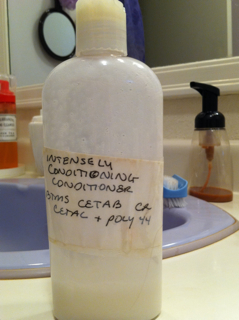
1.3% polyquat 44
1% fragrance oil
0.5% preservative

My recipe totals 100% and all is well. It's a pain to work with 1.3 grams or 0.5 grams so here are my suggestions - get a small scale that can weigh down to 0.1 grams or make larger batches. I never make less than a 10 times batch (1 kg) when I'm using a recipe I know I'll use a lot and want to store, like liquid conditioner, leave in conditioner, body wash, and so on. If I were to make this recipe for the first time, I'd make a small batch so I wasn't wasting supplies if I hated it!

As a note, if you want to make a small batch but don't have a small scale, you could multiply this recipe by 3 to make all those 1.3% turn into 4% (well, 3.9% but close enough!) and the 2.6% turn into 7.8%, which you could round up to 8%.

How did I know to multiply by 3 to get a rounder number? I don't know the name for it, but it seems logical that if we have something like 1.3 and 2.6, if we multiply by 3, we'll get a number we can round up to being a whole number. I've been looking for the mathematical explanation, but I can't find it. I just know that multiplying by 3 or a multiple of 3 will work well. 

If you're still a little intimidated by the math, click here for my post on not fearing math, then move on to this post on calculating percentages from weights and this one on converting from percentages to weight.

Join me tomorrow for more formulating fun!

Thursday, 11 August 2011

The great conditioner experiment: Results!

In June, I decided to undertake the great conditioner experiment to see just how much conditioner my hair might really need! (Click here for more information, although I'll summarize it below!) I've got below-my-waist length, coarse, oily, prone to frizzy hair, but other than the period of time where I went pink (look to your left), I don't dye, perm, or heat style my hair, so it should be in fairly good condition.

I made up a batch of my favourite conditioner, and I've been diluting it every other week or so to see how much water I can use in the product!

INTENSE CONDITIONER WITH A TON OF CATIONIC INGREDIENTS FOR REALLY DAMAGED HAIR

HEATED WATER PHASE
73.5% water
2% hydrolyzed protein
2% cetrimonium chloride

HEATED OIL PHASE
7% Incroquat BTMS
3% Incroquat CR
4% cetrimonium bromide
4% ethylhexyl palmitate

COOL DOWN PHASE
2% panthenol
2% dimethicone
2% cyclomethicone
2% cationic polymer
1% fragrance or essential oil
0.5% to 1% preservative

Experiment one: I added 50 grams of distilled water with 0.25 grams of liquid Germall Plus to 100 grams of product, which I used for 7 washings, using about 25 grams of conditioner per washing. My hair felt soft, shiny, defrizzed, and detangled. It's very watery, so I've taken to just squishing the bottle over my head and running it through my hair with my fingers, with an extra amount on the ends. I've managed to get three days between washings, so that's a fine thing indeed! (This was before the heat of the summer, as a note! That is relevant!)

Experiment two: I added 75 grams of distilled water with 0.37 grams of liquid Germall Plus to 100 grams of product. I used that for about 9 washings (I think it was 9 - I wrote it down, but someone threw the Post-It note out before I finished with it). I'm finding my hair is soft and shiny, but a little more fly-away than I would like. I'm not that worried about the frizzies right now, and I'm getting two to three days between washings. I would like three, but I don't think that's possible during the summer!

Experiment three: I added 100 grams of distilled water with 0.5 grams of liquid Germall Plus to 100 grams of product. I really don't like this - my hair doesn't really feel conditioned and I find I have to struggle to get the knots out (which defeats the purpose). I think this would make a really great leave-in product, but it doesn't work as a rinse off conditioner. I used this twice, then gave up.

So far, my favourite is experiment 1 with experiment 2 coming in second, although I did need to use a little more anti-frizz spray those days. Experiment 3 was a bust, and I'll reserve that for my leave in conditioning needs. The summer isn't a good time for me to experiment with my hair because I tend to be greasier because of all the sweating and being outside and things. (Cleaning the gutters the other day with the pressure washer wasn't exactly good for my hair, unless a moss and lichen soak is the new salon treatment I haven't heard about!)

How do I modify the conditioner recipe so I can make it as the experiment 1 or 2 version next time? Join me tomorrow for more detail on that question!

Wednesday, 18 May 2011

Duplicating products: Cleansing conditioners

Before we get into trying to duplicate a few cleansing conditioners, we need to establish what it means for a product to be a cleansing conditioner versus a normal conditioner. (For a quick summary of the no-shampoo method or co-washing method, click here.)

How does a cleansing conditioner differ from a normal conditioner? It doesn't. For the most part, the cleansing conditioner contains the same ingredients as a normal conditioner, although I've seen a few with very low levels of foaming surfactants like cocamidopropyl betaine. I have noticed that most of the conditioners with the word "cleansing" in the title tend to stay away from silicones, but that might be because those I've seen also bill themselves as natural or organic. I've also noticed that a lot of them contain mint, perhaps for the tingly feeling it can leave behind?

Please note that I don't adhere to the no-poo method and I don't know much about it. I'm not here to debate the merits of the method and whether it works or not. I'm just sharing information I've learned about the concept. 

If we take a look at something like the Wen Mint Sweet Almond Cleansing Conditioner (I've analyzed this product in more detail in this post), you'll notice very little difference between it and a product that isn't advertised as being cleansing. All conditioners will contain a cationic quaternary compound like behentrimonium methosulfate, behentrimonium chloride, cetrimonium bromide, stearalkonium chloride, or stearamidopropyl dimethylamine as the primary conditioning agent. Most will contain a fatty alcohol - cetyl, cetearyl, stearyl, or behenyl - to boost the conditioning of the cationic quaternary compound. All will contain some water and preservatives, and some might contain oils or modified oils. Everything else is just icing on the proverbial cake (for instance, panthenol, protein, silicones, fragrance, and so on).

If you want to learn more about what makes a conditioner a conditioner, click here or check out the hair care section of this blog! 

Why do they call it a cleansing conditioner? Because they can. This isn't to say that very dry or African hair types won't benefit from a cleansing conditioner, and this isn't to say a cleansing conditioner isn't a good conditioner, but you can get the same benefits co-washing or going no-'poo with just about any conditioner. (Although some will say to avoid conditioners with silicones because there could be some build up, I'd be more worried about the build up coming from things like polyquats and cationic guar. I wonder if not using heat styling or anti-frizz products is part of the no-poo concept, because those are chock full of silicones? Anyone using this method, can you advise?)

As a note, seriously? We're calling this no-poo? We can't come up with a better name for this process? 

You can make a conditioner with behentrimonium methosulfate, cetyl alcohol, water, and preservative and call it a conditioner or a cleansing conditioner. You can make a conditioner with cetrimonium bromide, cetearyl alcohol, water, preservative, mint essential oil, a bunch of botanical extracts, and coconut oil and call it a conditioner or a cleansing conditioner. Or you could make a conditioner with only behentrimonium methosulfate, water, and preservative, and call it a conditioner or a cleansing conditioner. For the most part, the main difference is the description of the product.

So let's take a look at a few cleansing conditioners and how we can duplicate them! Join me tomorrow for a look at Curl Junkie Daily Fix Cleansing Conditioner!

If you wish to make a suggestion for a product we might like to duplicate, please visit this post and provide an accurate ingredient list and link in a comment. 

Tuesday, 21 December 2010

Question: Can we make a clear leave in conditioner?

Sweeteababy0427 writes: I would like to know more about making liquid emulsifications. For example, like a leave in conditioner that has oils and water but I would like for it to stay in the liquid form and translucent (if possible). I saw you post about the spray leave in conditioner but I am thinking in general, if I wanted to make any product like that how would I do it? Which emulsifiers would I use? At what percentage?

If you want to use one of the cationic quats like Incroquat BTMS-50 or cetrimonium bromide, it isn't possible as they are emulsifiers and will make the product opaque. You could, however, use cetrimonium chloride, cationic polymers, and water soluble oils (esters) to make something clear, but it will be less conditioning than something made with our cationic quaternary compounds!

So what emollients could we use in this recipe? We need to use something water soluble, so we'll want to stick with esters like PEG-7 olivate (or another water soluble oil), Cromollient SCE, Caprol Micro Express (link at Lotioncrafters), or even oil mixed with polysorbate 80 as our emollients.

I would use cetrimonium chloride as my detangling and cationic ingredient at 2%, then add a cationic polymer like polyquat 7, honeyquat (although it will be slightly yellow), or polyquat 44 (my new Saturday night thing!) at the appropriate amount. I'd use polyquat 7 or honeyquat at 3% to 5% or polyquat 44 at up to 2% (although the suggestion is 0.5%, I would need more conditioning!).

So let's take a look at a few ideas (based on this post on detangling products)...

CLEAR, SPRAYABLE CONDITIONING PRODUCT WITH ESTERS

HEATED PHASE
water to 100%
1% Cromollient SCE or up to 5% PEG-7 olivate (or other water soluble oil) or up to 10% Caprol Micro Express
3% cetrimonium chloride
2% hydrolyzed protein

COOL DOWN PHASE
3% polyquat 7 or honeyquat or 0.5% polyquat 44
2% panthenol
0.5% preservative
1% fragrance oil

I'm not the biggest fan of using polysorbate 80 in hair care products as it can feel kind of sticky, so I'd keep it to 2% or lower, which means you can only use 2% oils in this recipe. If you want to make a clear emollient conditioner, I'd definitely go with one of the other esters, but I thought I would include this recipe to show you how it can be made.

Your conditioner will go the colour of your oils, so I would stick to clear oils like fractionated coconut oil or lightly coloured oils like sweet almond, sunflower, and so on.

CLEAR, SPRAYABLE CONDITIONING PRODUCT WITH POLYSORBATE 80
HEATED PHASE
water to 100%
3% cetrimonium chloride
2% hydrolyzed protein

COOL DOWN PHASE

3% polyquat 7 or honeyquat or 0.5% polyquat 44
2% panthenol
0.5% preservative
1% fragrance oil
2% oil of choice
2% polysorbate 80


You can use the general or alternate instructions for these recipes. But mix the oil and polysorbate together first, then add it to the conditioners.

As a side note, I've been playing around with Caprol Micro Express in hair care products and I'm quite enjoying it for my oily hair. As another side note, cetrimonium chloride is supposed to be an emulsifier but I've found it doesn't work well in that capacity. You can try it with small amounts of oils, but it will need shaking after a while.

Have fun formulating!