Showing posts with label facial product. Show all posts

Saturday, 19 November 2011

Experiments in the workshop: Facial cleanser with a ton of extracts - modified

I know I'm always going on about only switching one ingredient when you make a product, but when I'm in the workshop, I get a little ingredient happy and tend to change a whole lot of things at once! This is kinda what happened here with this somewhat unappealing looking facial cleanser. But seriously, try it out if you have oily skin - I'm loving this hideous abomination!

FACIAL WASH WITH A TON OF EXTRACTS IN A FOAMER BOTTLE
HEATED PHASE
28% water
10% aloe vera
10% rosemary hydrosol
10% chamomile hydrosol
3% glycerin
2% Phytokeratin (or any other hydrolyzed protein)
0.5% polyquat 44 (or another cationic polymer)
15% LSB or other gentle surfactant of choice
10% cocamidopropyl betaine

COOL DOWN PHASE
0.5% grapeseed extract
2.5% liquid green tea extract (water soluble)
0.5% chamomile extract
2% panthenol
0.5% to 1% preservative of choice (I'm using Germaben II here)

Weigh the heated phase of the product and heat and hold in your double boiler for 20 minutes at 70˚C. Remove from the heat and let cool to 45˚C to 50˚C, then add the cool down phase. To dissolve the powdered extracts, put them into a little container, like a shot glass, and add a little warm water - 3 to 5 grams or so - and stir until the mixture is uniform.

I love this facial wash! I've been using it for almost a year and I never get that tight feeling that comes from the surfactants not rinsing off, and my oily skin doesn't feel too stripped after using it.

So why these ingredients? I like to include aloe vera for its anti-inflammatory and soothing abilities. I'm using rosemary hydrosol because it's great for oily skin, and chamomile hydrosol for the anti-inflammatory properties, as well as the reduction in irritation and reduction in transepidermal water loss for up to 48 hours. I'm using grapeseed extract - which offers that weird brown-red colour - for the anti-oxidant properties, but I also like the resveratrol, which behaves as anti-inflammatory as well. Green tea extract is always a good choice for aging skin - and we all have aging skin - and I've chosen liquid green tea extract because I'm feeling like I have too many powders in the product and I am worried about getting precipitate on the bottom.

Powders are about solubility, so if we have too much powder, we can end up with that gunge on the bottom of the container, which is the precipitate or stuff that didn't dissolve. You can see it showing up on the bottom of toner two. It's not necessarily a bad thing - shake it up and you're good to go - but it doesn't look all that pretty, and it can clog up the tube or nozzle/pump of a dispenser. 

Glycerin is always my first choice as a humectant for a rinse off product for two reasons. I don't need a really fancy or expensive humectant if I'm just rinsing it off, and glycerin actually resists wash off better than something like sodium lactate or sodium PCA. (Click here for a list of humectants.) I like to add a hydrolyzed protein - this time I've chosen Phytokeratin - as it offers film forming and hygroscopic properties, and I'm adding a cationic polymer - in this case, polyquat 44 because it's new, but you can use any cationic polymer at the suggested rate. I like to include panthenol for its proven wound healing and hygroscopic abilities.

As for the surfactants, I'm using LSB (INCI: Sodium Lauryl Sulfoacetate and Disodium Laureth Sulfosuccinate) and cocamidopropyl betaine. I like the sulfosuccinates for my oily hair and skin because they're considered very mild, with good foaming and detergent properties. Sulfosuccinates are recommended for oily hair as they can remove oil and sebum gently without stripping hair too much, but all hair and skin types can use them without fear of harshness. I like SLSa because it has excellent foaming, bubbling, and lathering properties, as well as great cleaning properties. As for the cocamidopropyl betaine, I always include this surfactant as a secondary surfactant to increase mildness/reduce irritation and it can behave as a humectant, which is a great thing. (It can also help thicken our products, but that isn't an issue with the foamy bottles!)

So there you have this incredibly ugly coloured but pretty awesome facial cleanser! If you don't have a foamy bottle, feel free to increase the surfactants to 40% to 50% of the water phase, remove the same amount of water, and add some Crothix or salt at the end to thicken! (Click here and scroll down for a version I've thickened with Amaze XT.) If you want to alter this recipe, feel free to alter the surfactants (click here), the extracts (click here), or pretty much anything else.

Join me tomorrow for more fun with products!

Monday, 11 July 2011

Question: How can I increase the lather and foam in a facial cleanser?

In this post, The Fawn writes: I currently have coco glucoside on hand and would like to make a facial cleanser for myself. But I find that with coco glucoside at 30% as the single surfactant, there's very little bubble/lather and no foam at all. I am one of those people who wants LOTS of foam and lather if possible! :D I am looking at cocamidopropyl betaine, but not sure if it will give me enough foam and lather.
Could you advice me which surfactant I should add to the coco glucoside if I would like a cleanser that's gentle enough for sensitive but acne prone skin?

I'm not really sure why one would want a lot of foam and lather in a facial cleanser - don't you find it gets into your eyes and is hard to rinse off? - but we like a challenge around here. The easiest way is to put your product in a foamer bottle! Done! Lather and foam with even a small amount of surfactant! But I don't think that's the answer you wanted, so let's expand this further.

You'll want to use very mild and gentle surfactants for sensitive skin (click here for the posts on various skin types). Decyl glucoside is a mild surfactant and good foamer. Cocamidopropyl betaine is a great inclusion in any surfactant based products as it will increase the mildness and slightly thicken your product. If you have very oily skin, consider using C14-16 olefin sulfonate (maybe 5% to 10% in your product) and if you want creamy feeling lather, consider using SCI, which offers a moisturized after feel.

Here are a few ideas for facial cleansers...
Ideas for formulating facial cleansers
Creamy facial cleanser with SCI
Foamy facial cleanser
Some more ideas for a facial cleanser

If you're using coco glucoside on its own, you will need to make sure you alter the pH as it can be very high - between 7 to 11.5, check with your supplier to get the exact number - and we want our products to be between 5.5 and 6.5.

I really recommend spending some time getting to know your surfactants because our facial skin can get very grumpy at times. If you want to know more about surfactants, click here!

Let us know how it turns out!

Monday, 9 May 2011

Duplicating products: Burt's Bees Lip Shimmer

Pam suggested we take a look at Burt's Bees Lip Shimmer as a possible duplication.

Here's the ingredient list:
Ricinus communis (castor) seed oil, helianthus annuus (sunflower) seed oil, cera alba (beeswax, cire d'abeille), candelilla cera (euphorbia cerifera, cire de candelilla) wax, mentha piperita (peppermint) oil, lanolin, theobroma cacao (cocoa) seed butter, cera carnauba (copernicia cerifera, cire de carnauba) wax, tocopherol, rosmarinus officinalis (rosemary) leaf extract, glycine soja (soybean) oil, canola oil (huile de colza), limonene, May contain+/-: CI 77491/77492/77499 (iron oxides), mica, CI 77891 (titanium dioxide), CI 75470 (carmine), CI 778161(tin oxide)

I can break this down very quickly as follows (if you click on the links at the bottom of the page, you'll see reasons for using all these ingredients!)

  • Castor oil adds a lot of shine to a lip balm, so that's always a good addition for a lip balm. 
  • Sunflower oil has tons of linoleic acid, which is great for repairing skin's barrier mechanisms. 
  • Lanolin contains a lot of sterols, which are great for repairing skin's barrier mechanisms. 
  • Beeswax is essential to make it stiff, and you can use candelilla wax or carnauba wax for that purpose. 
  • Peppermint oil will give you a taste and a tingle of peppermint. 
  • The butters are in to make the product stiffer, and melt on contact with your skin. 
  • The oils are in there to create an occlusive layer. 
  • The tocopherol and rosemary leaf extract are there to retard the rancidity of the oils in the product. 
  • And the colours are in there to make the product coloured. 

There's a great basic lip balm recipe from Majestic Mountain Sage that I suggest to everyone wanting to start making lip balms...

20% Beeswax
25% solid at room temperature oil (Coconut Oil, Palm Oil, Shea Butter, Lanolin, etc.)
15% brittle at room temperature oil (Regular Cocoa Butter, Palm Kernel Oil, etc.)
40% liquid oil at room temperature (Sweet Almond Oil, Olive Oil, Avocado Oil, etc.)

If you're using a more brittle wax like candelilla or carnauba wax, you'll want to start at 10% wax because it can make it very hard!


Here are links to various posts on my site for making lip balms, lip shimmers, and lip sticks, as well as information on various ingredients!


Because a lip balm is such an individual thing, I'll refer you to the MMS recipe and my posts on how to make your starting recipe, then you can tweak it to get the same skin feel!

Join me tomorrow for more duplicating fun!

Sunday, 1 May 2011

Duplicating products: Philosophy's Purity Made Simple cleanser

Aesthete recommended this product, Philosophy's "cult" cleanser Purity Made Simple as a possible duplication. (If you want to make your own suggestion, visit this post and make a comment. Please make sure you give me a link and an ingredient list as I don't have time to track down all these products and oftentimes the names of the products are wrong!)

Water: Our solvent.

Sodium Lauroamphoacetate: Also known as disodium lauroamphodiacetate, it's basically the same thing as disodium cocoamphodiacetate only with "lauro" in place of "coco". In alkaline (over pH 8) products it will behave as an anionic surfactant and have good detergency. In acidic (under pH 6) products, it will behave as a cationic surfactant which will increase mildness and be substantive to our hair and skin, making it feel more conditioned. It's generally used at 1% to 50% in surfactant products, and can be used as a primary or secondary surfactant.

Sodium Trideceth Sulfate: Also known as sodium tridecyl ether sulfate, it's an alkyl ether sulfate like sodium laureth sulfate. It's considered a mild cleanser. It can also behave as an emulsifier for small amounts of oil.

Limnanthes Alba (Meadowfoam) Seed Oil: A light feeling oil that has a very long shelf life of up to two years despite loads of double bonded fatty acids

Coco-Glucoside: A non-ionic surfactant like decyl glucoside, these are considered very mild cleansers. It is derived from coconuts and is used to increase foaming and act as an emulsifier. It has a high pH, so you'll have to bring it down with some citric acid.

Coconut Alcohol:  Okay, this is playing with the rules because there's no such thing as coconut alcohol under INCI names. You have to use something like lauric alcohol or myristic alcohol or something like that, not "coconut alcohol". Okay, we get it, it came from coconuts, but what is it really? So many things are derived from coconuts, it's not fair not to give us the information. (On the official site they call it "cocos nucifera (coconut) alcohol", so no help there!) I'm going with the idea that it is probably lauric alcohol or myristic alcohol or another alcohol like stearyl alcohol.

Peg-120 Methyl Glucose Dioleate: This is sold as Glucamate DOE-120 (flakes or syrup) and it's a thickener for the surfactants. We could use another thickener in its place if you don't have this ingredient, like Crothix.

Aniba Rosaeodora (Rosewood) Wood Oil, Geranium Maculatum Oil, Guaiac (Guaiacum Officinale) Extract, Cymbopogon Martini (Palmarosa) Oil, Rosa Damascena Extract, Amyris Balsamifera (Balsam Torchwood) Bark Oil, Santalum Album (Sandalwood) Oil, Salvia Officinalis (Sage) Oil, Cinnamomum Cassia Leaf Oil, Anthemis Nobilis Flower Oil (Roman chamomile), Daucus Carota Sativa (Carrot) Seed Oil, Piper Nigrum (Pepper) Seed Extract: Various essential oils. (I'm not sure I'd want cinnamon and pepper on my face, but then again I hate pepper!)

Polysorbate 20: A high HLB emulsifier used to solubilize and disperse the oils and essential oils.

Glycerin: Our humectant. It could be part of another ingredient based on the fact that it's so far down the list.

Carbomer: This is a gelling agent used to make gels out of our products. Here's a post on how I make gels with surfactants. 

Triethanolamine: pH adjuster and thickener of carbomers. I'm thinking it's used for the latter.

Methylparaben, Propylparaben, Imidazolidinyl Urea: Preservatives!

Citric acid: pH adjuster (makes it more acidic, reduces pH).

Yellow 5 (Ci 19140): Colour.

So what do we have here? We have a cleanser filled with really mild surfactants - ones we would normally use as secondary surfactants - thickened with Glucamate DOE-120 and carbomer. There's something called coconut alcohol that I can't quite figure out - I'm thinking I'll use glycol distearate in its place if we want a pearlized product or a water soluble ester for moisturizing. We have a ton of extracts and essential oils that are solubilized with the polysorbate 20, and some meadowfoam seed oil.

Where does the 1% list start? Where the essential oils and extracts start. There's no way there is more than 1% of each of those ingredients in this product, so it's safe to say that's where we'll begin.

A side note on making the gel: I have concerns about using TEA as the reactant to gel the carbomer because it can raise pH. This is going to be a high pH product as it is, and if you don't have a pH meter, you won't know exactly how out of whack it might be. Coco-glucoside and disodium lauroamphodiacetate have really pH levels as it is, and given that they are in this product at higher than 5%, we're going to get a high pH product. So I'm going to use lye as the gel making thing. 

I'm going to use 1% carbomer and 1% 18% lye solution (dissolve 18% lye into 82% water and you have an 18% lye solution) to create the gel. Make sure you make this product in the right order because if you put the gel in last, you won't get much gelling.

Okay, let's create a duplicate recipe for this product.

Oh, one quick note! I'm sure they are using 10% or less of each surfactant, but I find I like more surfactants in my products, so I'm using 10% each of the two main surfactants and 5% of the third one.

And as another note, if you don't want to thicken this with gel or Glucamate (or Crothix), this would make a really nice foamer bottle recipe. I'd go with that option as it's easier! And feel free to substitute some of the water for aloe vera (I'd go with 10%) or hydrosols (lavender and chamomile are always nice for all skin types, and orange is nice for oily skin types).

POSSIBLE DUPLICATE FOR PURITY MADE SIMPLE CLEANSER
WATER PHASE
65% distilled water
10% disodium lauroamphodiacetate or disodium cocoamphodiacetate (or cocamidopropyl betaine)
10% sodium trieth sulfate (or sodium laureth sulfate or ammonium laureth sulfate)
5% meadowfoam seed oil
3% coco-glucoside or decyl glucoside
2% glycol distearate or other pearlizing ingredient (optional)
0.5% glycerin
1% carbomer
1% 18% lye solution

COOL DOWN PHASE
1% essential oil
1% polysorbate 20
0.5% preservative

Optional: Glucamate or Crothix or some other thickener you like at suggested usage rates.

Put the surfactants, oil, glycol distearate, and glycerin into a heatproof container and heat until the glycol distearate has melted really well. Remove from heat and allow to cool (this could take a while). If you aren't using the glycol distearate, ignore this step and go to the next one.

Mix the water and carbomer together and make sure you wet all the flakes. Depending on the type of carbomer, you could be waiting 3 to 20 minutes to ensure it's saturated. Add the 18% lye solution and stir really well until you get a gel. Add the surfactants and mix well.

In a small container, weigh whatever essential oils you want in the product into a small container. Add an equal amount of polysorbate 20 and mix well. Add to the gel mixture, then add the preservative, and you're done! Maybe...

If you want this to be thicker, wait until it has reached room temperature and then add your Crothix 0.5% at a time. I know this seems very low, but Crothix can make your product turn from watery to Jell-O in 0.5%. Make sure you stir it really well from the bottom of the container up because Crothix will go right to the bottom and stay there if you don't stir it well. You'll think the mixture is still really watery but in fact the Crothix is lurking there waiting to thicken it up!

If you want to make this for a foamer bottle, leave out the thickener, glycol distearate, and gel and make up those amounts in water.

Join me tomorrow for more duplicating fun with Ojon's 2 minute revitalizing hair mask!

Saturday, 30 April 2011

Duplicating products: Philosophy's Hope in a Jar

I've already broken down the ingredients for the Hope in a Jar in this post, but I'll repeat it here with an eye to duplicating it. As a note, this is the Hope in a Jar product, not one of the variations (click here for the Sephora link). And as a note, I don't see any difference in the ingredient lists for the dry skin version, but there could be differences in the amount of the ingredient used.

Water - the solvent.

Glycerin - our humectant.

Rice Bran oil - our oil. Shelf life about 12 months.

C12-15 alkyl benzoate - an ester that feels light and offers good slip and glide, as well as fragrance fixing properties. Shelf life about 24 months.

Glyceryl stearate - part of the emulsification system. A low HLB emulsifier (5.8) that is used with a high HLB emulsifier to create an emulsification system.

PEG-100 stearate - a PEG ester that comes in a waxy format. It acts as a thickener, opacifier, and emulsifier. It's probably part of the emulsification system along with glyceryl stearate as the high HLB emulsifier (18.8).

Octyldodecanol - A fatty alcohol, but one that comes in a liquid form. It offers thickening and emolliency to our products as well as stabilization of emulsions and a reduction of foam when a product is shaken.

As an aside, this is a Guerbet alcohol, which is a branched chain fatty alcohol that will have a much lower melting point than a regular fatty alcohol like cetyl alcohol. This means it is liquid at room temperature. If you want to learn more about the differences between regular fatty alcohols and Guerbet alcohols, click here. If you want to learn a lot more, click here. And if you want to learn even more and learn more about how they are made and learn about Guerbet acids, click here.

Cetyl Alcohol - A fatty alcohol that offers slip and glide, as well as thickening to our products. Also acts as an emollient. It has a required HLB of 15.5.

Stearyl Alcohol - A fatty alcohol that will offer thickening to our products and it acts as an emollient. It has a required HLB of 15.5.

Lecithin - An emollient and emulsifier. It could work as an emulsifier in this product with an HLB of 4 of 9.7.

Tocopheryl Acetate - Vitamin E. Behaves as an antioxidant. It has a required HLB of 6. Generally used at 1% or less (and probably far less for a commerical product).

Retinyl Palmitate - Vitamin A. Good for your skin. It has a required HLB of 6.

Arachidyl Propionate - A semi-solid wax that melts on contact with our skin. It's non-greasy feeling. Required HLB is 7.

Ethyl Linoleate - an ester of linoleic acid. It can be used as an emollient or fragrance ingredient. It has an HLB higher than 10.

Ethyl Linolenate - an ester of linolenic acid. It can be used as a fragrance or flavour ingredient. It has an HLB higher than 10.

Citric Acid - pH adjuster. Used at 0.2% to reduce the pH about 0.9.

Lavandula Angustifolia (Lavender) Oil, Salvia Officinialis (Sage) Oil, Limonene & Linalool - fragrance ingredients

Diazolidinyl Urea, Phenoxyethanol, Methylparaben, Propylparaben - preservatives

So here's the problem with this product. Where can we find octyldodecanol, arachidyl proprionate, ethyl lineolate, and ethyl linolenate? I have no idea. The last three are probably in small amounts as they come after the Vitamin E and A, so we could substitute them for other esters, but the octyldodecanol is just behind the emulsifiers, so we know we'll need it at least 1%, and it seems pretty important for the skin feel and the emulsification of the product.

The other problem is that we don't know if the ethyl linoleate and linolenates are in there as fragrance products or skin feel products. Do they have a role in how the product feels or smells? If it's about the smell, then we can add other things to make it fragrance. If it's about the skin feel, even a small change can make a difference in our products. I'm going with the notion that these esters are for fragrance, so I won't worry too much about leaving them out, but I could be wrong, and the skin feel might be different.

We could substitute some other esters for these ingredients (except the octyldodecanol), but it won't have the same skin feel as the original. I know they probably don't make up a lot of the product - they're in the 1% or less category - but a little change can make a big difference. As for the octyldodecanol, I think this is a really important ingredient, but I can't find it anywhere, so we'll have to leave it out and hope we can get the skin feel in other ways.

And one final problem - I'm also not that sure where to get stearyl alcohol on its own. We can get cetearyl alcohol, which is a mix of cetyl alcohol and stearyl alcohol (sometimes it's 50-50, sometimes it's 30-70), so we could use that in our product (which would make sense because we see the cetyl alcohol above the stearyl alcohol).

And a final note. Lecithin can be used as an HLB emulsifier with an HLB of 4 or 9.7. Since I have no idea which lecithin I own, I'm going with the idea that this is another oil. I'll add it to the oil phase at 1% without an HLB amount (so I won't count it in the calculations of how much emulsifier I'll need). If you know the HLB value of your lecithin, you can use it as you calculate your emulsifier with the glyceryl stearate (HLB 5.8) and the PEG-100 stearate (18.8).

I think the key to this product is making it thickish without making it greasy. I'm thinking about cetyl esters as a replacement for octyldodecanol. I know it's not a great replacement, but it will offer thickening and emolliency. I'll try those at 3% and I'll try the cetearyl alcohol at 2%. (The HLB will be the same for cetearyl alcohol as it is for cetyl alcohol and stearyl alcohol - 15.5.)

I think there's maybe 3% rice bran oil, 3% C12-15 alkyl benzoate in here (I'm going by the fact that the glycerin appears higher than these two oils), but I'm going with 5% of each because it's easier for me to make something thicker for a first try and then reduce the oils. Because we don't have the octyldecanol, we need some emollients in here beyond the fatty alcohols.

So which ingredients are oil soluble and have HLB values? It makes up 16% of the recipe.
5% rice bran oil - HLB 7 -
5% C12-15 alkyl benzoate - HLB 13
3% cetyl esters - HLB 10
2% cetearyl alcohol - HLB 15.5
0.5% Vitamin E - HLB 6
0.5% lavender essential oil - HLB 12

Our required HLB for this product is 10.625. Wow, that's high! So if we're using glyceryl stearate (HLB 5.8) and PEG-100 stearate (18.8), we'll need to use 2.52% glyceryl stearate and 1.48% PEG-100 stearate (and it's okay to round those to 2.5% and 1.5% respectively in this case).

Yes, essential and fragrance oils have HLB values and we can figure those out for our products. Most fragrance oils are around HLB 7 and a lot of our essential oils are in the 12 to 13 HLB range. You don't really need to include them in the calculations because you're not using a lot and if you're using 4% to 5% emulsifier, you have enough to compensate for them. I'm including the lavender essential oil in this calculation to round it up to 16% instead of working with 15.5% as my oil phase. Plus, it's good to know these things! 

If you want to use an emulsifier like Polawax, BTMS-50, or e-wax, with a 16% oil phase you'd use about 4% emulsifier. If you're using another emulsifier - like Ecomulse/Natramulse - you'll have to use it at its suggested rate and remove some of the water to compensate (it's a coincidence that it's 4% for each).

For the water phase, we have two ingredients - water and glycerin. I'm thinking about the glycerin at 3% and the water will make up the rest of the product.

Let's take a look at a possible duplicate recipe...

POSSIBLY A DUPLICATE FOR PHILOSOPHY'S HOPE IN A JAR
HEATED WATER PHASE
75.5% water
3% glycerin

HEATED OIL PHASE

5% rice bran oil
5% C12-15 alkyl benzoate
3% cetyl esters
2% cetearyl alcohol
1% lecithin
4% emulsifier (2.5% glyceryl stearate and 1.5% PEG-100 stearate or a complete emulsifier like Polawax, e-wax, or Incroquat BTMS-50).

COOL DOWN PHASE
0.5% Vitamin E - HLB 6
0.5% lavender essential oil - HLB 12
0.5% preservative

Follow the basic lotion making instructions for this recipe.

As you can see, duplicating products isn't as easy as it seems! Commercial products will often use a little bit of something you can't get, and as we know, a small change can have a huge impact. Play with this recipe to get the skin feel you want. Try different esters, more fatty alcohols or fewer, and get to a point where it feels more like the real product!

Join me tomorrow for more fun duplicating products with Philosophy's "cult" cleanser Purity Made Simple (another suggestion from Aesthete!)

Friday, 29 April 2011

Duplicating products: Liz Earle Gentle Face Exfoliator

Sarah suggested the Liz Earle Gentle Face Exfoliator as a possible duplication, so let's take a look at it! (If you want to make your own suggestion, please click here and make a comment. Please include the ingredient list and a link to make my life easier!)

Aqua (water): Our solvent.

Caprylic/capric triglyceride: Fractionated coconut oil. A very light feeling oil with a shelf life of about 2 years. (HLB 5)

Theobroma cacao (cocoa) seed butter: A very moisturizing and occlusive butter. (HLB 6).

Jojoba esters: These are the beads you find in the product. They are fully hydrogenated jojoba esters to create these small beads. They are generally used at 1% to 15%.

Cetyl esters: A thickener that is lighter than cetyl alcohol. It has a shelf life of about 2 years. Generally used at 1% to 5%. (HLB 10)

Glycerin: A good humectant generally used at 1% to 5% (it can get kind of sticky at higher amounts).

Cera alba (beeswax): Used to thicken products and create a waterproof layer. (HLB 12).

Polysorbate 60: A high HLB (15) emulsifier that can be combined with a low HLB emulsifier to create an emulsification system.

Sorbitan stearate: A low HLB (4.7) emulsifier that can be combined with a high HLB emulsifier to create an emulsification system.

Eucalyptus globulus (eucalyptus) oil: An essential oil.

Prunus amygdalus dulcis (sweet almond) oil: A light feeling vegetable oil with 10% to 30% linoleic acid. It has a shelf life of about 12 months. (HLB 7)

Panthenol: Vitamin B5 used for moisturizing.

Cetearyl alcohol: Like cetyl alcohol, it's a fatty alcohol that thickens our products, leaving a waxier feeling than cetyl alcohol or cetyl esters. It has about a 2 year shelf life.

Sodium hydroxide: This is used to increase pH.

Limonene: A component of essential oils.

Phenoxyethanol: A preservative. Can be found with benzoic acid and dehydroacetic acid in Optiphen ND.

Benzoic acid: A preservative. Can be found in Optiphen ND with phenoxyethanol and dehydroacetic acid in Optiphen ND.

Dehydroacetic acid: Fungicide and bactericide. (Click here for the Wiki link.) Can be found in Optiphen ND.

Ethylhexylglycerin: Preservative. Could be used to suspend phenoxyethanol.

Polyaminopropyl biguanide: A preservative. Can be found as Cosmocil CQ.

What kind of product do we have here? We have a very well preserved oil in water lotion with a shelf life of about 1 year (the sweet almond oil ruins the possible 2 year life span of the product). It is made using polysorbate 60 and sorbitan stearate as the emulsifiers with cetyl esters and cetearyl alcohol to thicken it. It contains jojoba ester beads as an exfoliant, so we know it's intended to be removed, most likely with a cloth of some kind rather than rinsing.

Where do you think the 1% category starts? I'm thinking with the essential oil (eucalyptus) because you wouldn't want more than 1% of this particular oil on your face. So everything below that will be at 1% or less.

How do we figure out how much we need of each ingredient? I'm thinking about 10% fractionated coconut oil, 5% cocoa butter (we don't want it too thick), 3% cetyl esters, 3% glycerin, 2% beeswax, 1% sweet almond oil, and 1% cetearyl alcohol, for a total oil phase of 25%. I'm not counting the cetyl esters in the oil amount. Although they are an ester, they aren't being emulsified into the product, so we don't need to include them when figuring out the oil phase. (Start with 10% jojoba ester beads and work up or down depending upon your preferred skin feel.)

Let's use the HLB system for this product. If you prefer to use e-wax, Polawax, or BTMS-50, you'll want to use those at about 25% of the oil phase, so 25% of 25% = 6.25%.

Fractionated coconut oil - 10% of oil phase, 10/25 = 0.4 x 5 = 2.00
Cocoa butter - 5% of oil phase, 5/25 = 0.20 x 6 = 1.20
Cetyl esters - 3% of oil phase, 3/25 = 0.12 x 10 = 1.20
Beeswax - 2% of oil phase - 2/25 = 0.08 x 12 = 0.96
Sweet almond oil - 1% of oil phase - 1/25 = 0.04 x 7 = 0.28
Cetearyl alcohol - 1% of oil phase - 1/25 = 0.04 x 1.5 = 0.62
For a total required HLB of the oil phase of 6.26.

If our emulsifiers are sorbitan stearate (HLB 4.7) and polysorbate 60 (HLB 15), then we'll need 85% sodium stearate (0.85 x 4.7 = 3.995) and 15% polysorbate 60 (0.15 x 15 = 2.250) for a total HLB of 6.245 (and we want 6.26, so close enough!) If we're using 5% emulsifier, we'll need 4.25% sodium stearate and 0.75% polysorbate 60.

Let's take a look at our recipe using HLB emulsifiers (with information afterwards on how to make this with Polawax).

POSSIBLE DUPLICATION FOR LIZ EARLE GENTLE FACE EXFOLIATOR
HEATED WATER PHASE
57.5% water
3% glycerin

HEATED OIL PHASE
10% fractionated coconut oil
5% cocoa butter
3% cetyl esters
2% beeswax
4.25% sorbitan stearate
0.75% polysorbate 60
1% sweet almond oil
1% cetearyl alcohol

COOL DOWN PHASE
0.5% to 1% eucalyptus oil
1% panthenol
0.5% to 1% preservative

REALLY COOLED DOWN PHASE
10% jojoba esters

Follow the basic lotion making instructions for this product.

When the product has cooled to room temperature, mix in the jojoba ester beads then bottle. If you like it less scrubby, start at 5%. If you want it more scrubby, start at 10% and increase it up to 15% if you want it even scrubbier! I like to use the 60/100 jojoba beads as they are very small and don't end up sticking to my skin. You can get smaller and larger beads - choose what you like.

These purple ones are from Voyageur. I'm sure you'd want something more adult and sophisticated like the white ones, but the coloured ones are fun! I use the white ones in my cleanser because my friends think the coloured ones look a little weird, plus I could only find the 60/100 in white. 

If you want to use e-wax or Polawax, follow the rule of thumb for this product (for Polawax it's 25% of the oil phase, which means we need 6.25% Polawax) and reduce the amount of water by the same amount (so you need to take 1.25% out of the water amount for a total of 56%).

If you want to make a foaming moisturizing cleanser with jojoba ester beads, click here for my favourite recipe. And here's how to modify it for oily skin.

Join me for more fun duplicating products tomorrow!

Duplicating products: Pear & Poppy Seed Microderm Polisher

In the duplicating products post, Lana asked if we could duplicate this product, the Pear & Poppy Seed Microderm Polisher...

Pyrus Communis (Pear) Pulp, Pyrus Malus (Apple) Pulp, Pyrus Communis (Pear) Juice, Pyrus Malus (Apple) Juice, Papaver Somniferum (Poppy) Seed, Juglans Regia (Fine Walnut) Exfoliant, Silica, Vegetable Glycerin, Cyamopsis Tetragnoloba (Guar) Gum, Plantago Lanceolata (Plantain) Extract, Camellia Sinensis (Green Tea), Prunus Armeniaca (Apricot) Kernel Oil, Alfalfa, Mica, Glycolic Acid, Vegetable Squalene, Ubiquinone (Coenzyme Q10), Tocopheryl Actate (Vitamin E), Ascorbyl Palmitate (Vitamin C Ester), Glycine Soya (Soybean) Oil

And honestly, I don't think we can. If you take a look at the list, it's filled with all kinds of fruit juices and pulps, but we don't see a good preservative in there. Yes, we could make it and use our own preservatives and keep it in the fridge and use it for a week, but making something like this at home will result in a really ugly product (think about what an apple looks like when the inside is exposed to oxygen!) that won't be good for more than a few hours. We see some oils in there - apricot kernel, squalene, Vitamin E, Ascorbyl Palmitate, and soy bean oil - but there's no emulsifier.

If you really want to try making this product, here's a thought...Remove all those pulps and juices out of the mix and start with the ingredient list around the glycerin (we'll add the exfoliants later). The key to this recipe is the guar gum. We need to hydrate it before using it in our products, so it's suggested that you sprinkle the guar gum over your room temperature water phase, stick blend or mix well, then leave to sit for about 15 minutes or so or until it is well hydrated (you'll be able to tell because it creates a gel). Then you can add your other water phase ingredients like aloe vera, hydrosols, proteins, and so on and heat and hold as usual. The usage suggested ranges between 0.3% to 5%, so you'll have to do some playing to figure out the best usage for your product. Guar can emulsify small amounts of oils, and looking at the ingredient list, if the maximum usage for guar is 5%, then we can see that everything that comes below it would be at 5% or less.

If we used each of the oils at 1% or less (1% apricot kernel, 1% squalane, 0.5% Vitamin E, 0.5% Ascorbyl Palmitate, 0.5% soy bean oil), then we might just have enough guar gum (if we use 5%) to emulsify those things. Try making this product, then add the various exfoliants and cosmeceuticals and see if you like it. Make sure you preserve this properly - see this section for information on preservatives and usage rates - and don't try it with the fruit juices!

Sorry I couldn't be more helpful here, but I really don't see how this product is possible with all those ready to go bad juices and pulps. But I think you could make a nice scrub with the guar gum, some exfoliants, and some oils. (As a note, I think the green colour comes from the alfalfa they're using and not the actual juices and pulps, and perhaps from the mica.)

If you want to make a suggestion for a product we could try duplicating, please click on this link and make a comment! Please include the ingredient list from a reputable source and a link to the product so I don't have to search all over the 'net for it! 

Thursday, 21 April 2011

Duplicating products: Korres Milk Proteins 3 in 1 cleansing emulsion

Jen W. suggested this product for duplication in this thread (which is where you can go to add your suggested product): Korres Milk Proteins 3 in 1 cleansing emulsion

Ingredient list: Aqua (Water), Helianthus Annuus (Sunflower) Oil, Squalane, Carthamus Tinctorius (Safflower) Seed Oil, Glycerin, Macadamia Ternifolia Oil, Dicaprylyl Ether, Pentylene Glycol, Dicaprylyl Carbonate, Olivoyl Hydrolysed Wheat Protein, Sucrose Stearate, Lactose, Whey Protein, Arginine, Ascorbyl Palmitate, Ascorbic Acid, Benzyl Alcohol, Cetearyl Alcohol, Citric Acid, Glyceryl Oleate, Glyceryl Stearate, Isohexadecane, Methylparaben, PEG- 8, Polysorbate-80, Propylparaben, Tocopherol, Sodium Acrylate/ Acryloyldimethyl Taurate Copolymer, Sodium Gluconate.

All right, let's break it down!

Water: Our solvent.

Sunflower oil: A light feeling oil with a shelf life of 6 to 12 months filled with linoleic acid.

Squalane: A thicker feeling oil that is found in our skin.

Safflower oil: Much like sunflower oil, it's a light feeling oil filled with linoleic acid.

Glycerin: Our humectant. It will draw water from the atmosphere to our skin and make it feel more moisturized.

Macadamia nut oil: A light feeling dryish oil with a shelf life of about 12 months filled with oleic acid and palmitoleic acid.

Dicaprylyl Ether: (aka dioctyl ether or ethylhexyl-2-ethyl-hexylether) It's a high spreading, dry feeling emollient that leaves a silky feeling.

Pentylene Glycol: Another humectant, like propylene glycol or hexylene glycol but with 5 carbon atoms.

Dicaprylyl Carbonate: A dry emollient that provides a protective film on our skin that has excellent spreadability and a velvety after feel. It is considered a silicone alternative.

Olivoyl Hydrolysed Wheat Protein: With the cetearyl alcohol, glyceryl oleate, and glyceryl stearate, this makes up the emulsifier called Olivoil glutinate E (scroll down to page 5) from Kalichem Italia. It is used at 3% to 10% as the emulsifier (so in the heated oil phase) and has a 1 year shelf life.

Sucrose Stearate: An emulsifier derived from combining sugar and stearic acid. (Click here for a list of data sheets from various companies about this ingredient).

Lactose: Derived from milk, it's a skin conditioning agent and humectant.

Whey Protein: It behaves as a skin and hair conditioning agent.

Arginine: An alkaline amino acid used in our products as an anti-oxidant and possible wound healer.

Ascorbyl Palmitate and Ascorbic Acid: Vitamin C. Ascorbyl palmitate is a more stable version. Could be used as an anti-oxidant, could be used for the benefits to our skin.

Benzyl Alcohol: A bacteriostatic preservative (click here for the Wiki entry or here for the CosmeticsInfo entry). It can be safely used at up to 5%.

Cetearyl Alcohol: Part of the emulsifier, it's a longer chain fatty alcohol than cetyl alcohol that offers emolliency and thickening.

Citric Acid: Chelating, anti-oxidizing, and pH adjust ingredient.

Glyceryl Oleate and Glyceryl Stearate: Part of our emulsifier.

Isohexadecane: A form of mineral oil.

Methylparaben: Preservative.

PEG- 8: Not enough information to figure out which PEG-8 this is.

Polysorbate-80: Dispersant and solubilizer.

Propylparaben: Preservative.

Tocopherol: Vitamin E, our anti-oxidant.

Sodium Acrylate/ Acryloyldimethyl Taurate Copolymer: Found at Making Cosmetics as Gelmaker EMU (which also contains polysorbate 80 and isohexadecane, which we see in this ingredient list), it's a thickener that we can add at 0.5% to 2% in the heated water or oil phases or when we combine the two. It makes gels. Here's a data sheet on Creagel EZ if you're interested in learning more!

Sodium Gluconate: A chelating ingredient (click here for more information on the ingredient).

What kind of product do we have here? It's an oil in water emulsified lotion used as a cleanser (which is in the name!)

Where do you think the 1% category starts? It's hard to say. I would say citric acid on down is definitely in the 1% category, but it could be higher with the proteins or even the wheat protein that is part of the emulsifier. I'm going to go with the idea that the 1% list starts with the wheat protein for the purposes of trying to duplicate this recipe.

I'm not sure of the viscosity of this product, but I've seen a picture so I know it's about a 70% to 80% water recipe. I'll go with the 80% water recipe I use for moisturizers and hope I'm close!

I don't have any lactose or whey protein, so I'll substitute another protein for this (I like oat protein, but you can use any you like). You can use any kind you want or find the lactose somewhere (sorry, not sure where). I don't have arginine either, so I'll have to leave that out, too.

I'm going to be using sunflower, squalane, and macadamia nut (I don't have any safflower) and I'm using dimethicone at 1% for the dicaprylyl carbonate and 1% cetearyl ethylhexanoate for the dicaprylyl ether. If you don't have the ester, increase the macadamia nut oil by 1% (it's also a dry oil) and increase the squalane by 1% if you don't want to use the silicone. I don't have access to the emulsifier in the product, so I'll use Polawax at 4% of my oil phase (my oil phase will be 10%, but I find anything lower than 4% can be unstable, so that's the amount I'll use even though it's not 25% of the oil phase). I'm adding 1% cetyl alcohol here (or cetearyl alcohol) to thicken it slightly, but not too much. (I'm using cetyl alcohol instead of cetearyl alcohol as I find that kind of waxy feeling. Feel free to use either.)

I'll use 3% glycerin and 1% propylene glycol as I don't have hexylene glycol. (If you don't want to use propylene glycol, increase the glycerin to 4%). I'll add the 0.5% Gelmaker EMU to the heated water phase. If you don't have the Gelmaker, leave it out. It will make the lotion feel less cushiony (yes, that's an actual description) but it won't ruin the product.

Finally, I'll include 0.5% Vitamin E and 0.5% Vitamin C (in a stable form) in the cool down phase.

POSSIBLE DUPLICATION FOR KORRES MILK PROTEIN 3 IN 1 CLEANSING EMULSION
HEATED WATER PHASE
78% water
2% hydrolyzed protein
3% glycerin
1% propylene glycol

HEATED OIL PHASE
4% emulsifier
1% cetyl or cetearyl alcohol
3% sunflower oil
2% squalane
2% macadamia nut oil
1% cetearyl ethylhexanoate

AFTER EMULSIFICATION
0.5% Gelmaker EMU

COOL DOWN PHASE
0.5% Vitamin E
0.5% stable Vitamin C (leave out if you don't have it)
0.5% preservative (I use liquid Germall Plus)
1% dimethicone

Weigh the heated water phase ingredients in a heatproof container and put into a double boiler. Heat and hold for 20 minutes at 70˚C. Weight the heated oil phase ingredients in a heatproof container and put into a double boiler. Heat and hold for 20 minutes at 70˚C. When the ingredients have heated and held, remove the heated oil phase from the double boiler and add the Gelmaker and mix well. Add the heated water phase to the heated oil phase and mix well. When the mixture reaches 45˚C to 50˚C, add the cool down phase ingredients and mix well. Allow to cool to room temperature and bottle!

If you want this to be a little thicker, here are two posts on the topic: Part one and part two.

Join me tomorrow as we start a short aside on HLB emulsifiers, what they are and how to make our own before we return to a few more duplicating posts!

Wednesday, 20 April 2011

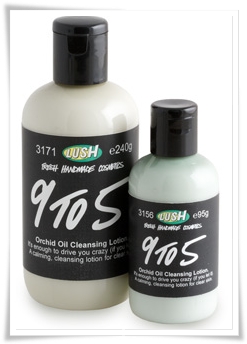
Duplicating products: Lush's 9 to 5 cleanser

In this post (where you can suggest a product for duplication), soapilyever after suggests:  LUSH, a no rinse facial cleanser called 9 to 5. here are the ingredients: Water (Aqua), Almond Oil (Prunus dulcis), Stearic Acid, Fresh Dove Orchid Extract (Dendrobium), Everlasting Flower Absolute (Helichrysum stoechas), Ylang Ylang Absolute (Cananga Odorata), Triethanolamine, Cetearyl Alcohol, Perfume, Methylparaben, Propylparaben.

Okay, let's take a look at each ingredient individually. As usual, click on the link to find out more about each ingredient.

Water (Aqua): Our solvent.

Almond oil (Prunis dulcis): A light feeling oil with a shelf life of 9 to 12 months. I'm not sure if this is sweet almond oil as it has a different name.

Stearic acid: A thickener that makes a product more like a cream. Generally used at 1% to 3% in products.

Fresh Dove Orchid Extract (Dendrobium): The dove or pigeon orchid most common in Malaysia and Singapore. It only smells for two days! You can find generic orchid extract at some suppliers. It is claimed to reduce the look of fine lines and wrinkles, behave as a humectant, moisturize, soothe, and condition skin. It can be found as a water soluble or oil soluble extract and the suggested usage is 3% to 8%. I think it's probably used here at lower levels because it comes after the stearic acid.

Everlasting flower absolute (Helichrysum stoechas): This is helichrysum, not the marsh cudweed we saw in another product. It is supposed to be an anti-inflammatory, anti-microbial, astringent, and anti-allergy ingredient, as well as stimulating cell regeneration. There isn't a ton of information out there to support the claims, and it's a really expensive ingredient!

Ylang Ylang Absolute (Cananga Odorata): Essential oil that offers anti-spasmodic and calming properties.

Triethanolamine: Added at 0.1% to increase pH. Combine with stearic acid to create a soap based emulsifier. (Click here for slightly more information.)

Cetearyl Alcohol: A fatty alcohol that thickens our products and has a more waxy feeling than cetyl alcohol.

Perfume: Makes it smell pretty.

Methylparaben, Propylparaben: Preservatives.

So what can we learn from the ingredient list? This is an oil in water lotion used for cleansing our face. Any oil in water lotion would do, but that's not the point of this exercise!

We see the emulsifier is likely to be TEA combined with stearic acid. I don't like that combination, so for now we'll use something like Polawax, e-wax, or BTMS-50 as most of us don't really have those ingredients just lying around the house.

I think the orchid extract could be replaced by an extract of some kind - choose one you like- and I'll add a humectant to the mix because it can act in that capacity. Choose one you like - tamarind seed extract, glycerin, sodium lactate, sodium PCA, honeyquat, and so on - and add it around 1% to 2%.

How do we figure out how much to use of each ingredient? I'm not really sure where the 1% part of the list starts. It could be below stearic acid with the extracts or it could be with the helichrysum. I'm going to guess the orchid extract is found at 1% or less, so I'll consider this where the 1% category starts. I guess the cetearyl alcohol comes in around 1% or so, so I know I'll need water, almond oil, stearic acid, and emulsifier at more than 1%, and the rest of the ingredients at 1% or less.

I know this is supposed to be very liquidy, so I'm looking at something like a 80% water recipe, on par with a moisturizer. So let's take a look at how to create a possible duplicate for this recipe.

POSSIBLE DUPLICATE FOR LUSH'S 9 TO 5 CLEANSER
HEATED WATER PHASE
2% humectant of choice
78.5% water

HEATED OIL PHASE
10% almond oil (sweet almond oil, if you want, or another light feeling oil)
3% stearic acid
1% cetearyl alcohol
4% emulsifier

COOL DOWN PHASE
1% fragrance or essential oil (optional because it's on your face)
0.5% to 1% preservatvive

Use the basic lotion making instructions for this product. Substitute any oils you like in place of the almond/sweet almond oil. If you want something a little heavier and more moisturizing, choose a heavier oil. If you want something drier feeling, choose a drier feeling oil and use BTMS-50 as your emulsifier.

Why did I use 4% emulsifier for 14% oils (so it should have been 3.5%)? Because I find anything with less than 4% emulsifier tends to be a little less stable.

So there you have it. A possible duplicate for this Lush product. It's a pretty simple product, but it sounds like it would work really well as an oil cleansing type product.

Join me tomorrow for Korres Milk Proteins 3 in 1 cleansing emulsion, then we're off to do a little series on HLB emulsifiers before returning to more duplicating!

Friday, 15 April 2011

Duplicating products: Kiehl's Midnight Recovery Concentrate

Angelica suggested in this post (which is where you can post your ideas for duplicatable products) that we take a look at Kiehl's Midnight Recovery Concentrate. So let's take a look at the ingredient list...

Caprylic/Capric Triglycerides: Fractionated coconut oil. It's a dry feeling very light emollient with a 2 year life span. It feels like our esters. No doubt this makes up the majority of this product.

Dicaprylyl Carbonate: A dry emollient that provides a protective film on our skin that has excellent spreadability and a velvety after feel. Sounds like an ester to me! (We'll look at how to replace this in the notes below.)

Squalene: Generally derived from olive oil, it's something we find in our skin and it sinks in nicely. Two year shelf life.

Rosa Canina Fruit Oil: Rosehip oil. Wound healing, scar reducing, and cell regenerating oil with tons of carotenoids or Vitamin A. Not great for those of us with acne prone skin.

Oenothera Biennis Oil/Evening Primrose Oil: A dry feeling exotic oil that contains a ton of gamma-linoleic acid, which is great for helping skin's barrier mechanisms repair faster.

Simmondsia Chinensis Oil/Jojoba Seed Oil: More of a wax than an oil, it penetrates into our skin through the hair follicles and creates a light occlusive layer on our skin.

Coriandrum Sativum Oil/Coriander Seed Oil: An essential oil.

Tocopherol: Vitamin E. Our anti-oxidant.

Lavandula Angustifolia oil/Lavender Oil: An essential oil.

Pelargonium Graveolens Flower Oil: Rose geranium oil. An essential oil.

Linalool: A component of essential oil.

Rosmarinus Officinalis Leaf Oil/Rosemary Leaf Oil: An essential oil that offers anti-oxidant properties and is good for oily hair and skin.

Citronellol, Geraniol: Components of essential oil.

Lavandula Hybrida Oil: Lavendin essential oil. Avoid during pregnancy due to camphor content.

Cucumis Sativus Extract/Cucumber Fruit Extract: This contains polysaccharides, which are great for creating a light film on our skin, but I'm not sure how it is incorporated into this product as it's generally a water soluble extract. I'm wondering if it's cucumber oil (which I found at From Nature with Love for $18.31 per ounce and people report it feels sticky). Or it could be somehow incorporated in the sunflower seed oil below.

Curcuma Longa Extract/Turmeric Root Extract: Reported to be an anti-aging agent in India, it can be used as an anti-bacterial ingredient. It can stain the skin at higher levels of usage.

Limonene: A component of essential oil.

Citral: A component of essential oil.

Sclareolide: Used as a fragrance.

Rosa Spp/Rose Flower Oil: An essential oil and fragrance.

Jasminum Officinale Extract/Jasmine Extract: An essential oil and fragrance.

Helianthus Annuus Seed Oil/Sunflower Seed Oil: A greasy, light feeling oil with a lot of linoleic acid. I think it's used here as a carrier for something else, likely the tumeric and cucumber extracts.

We have here is an anhydrous serum that should feel very light and moisturizing. It has a lot of essential oils that can be considered good for skin, and it contains quite a number of dry feeling and light oils that should feel like they penetrate quickly so we don't have a greasy shine on our faces.

How the heck do we figure out how much of what is in this? Look at the coriander oil. It's considered to have a strong aroma, so we're not going to use 10% in this product, so I'm going to suggest that's the place where we consider the miscellaneous category to start. I'm going to guess that everything below that will be at 1% or lower, especially considering the Vitamin E and lavender follow. I'm a little confused by the sunflower seed oil coming at the very end, but I think that's because it's likely in here because something else was dissolved in it and it's listed because it was a component of that ingredient.

So my main oils will be the fractionated coconut oil, dicaprylyl carbonate, squalane, evening primrose, rosehip, and jojoba oils, with the rest of the ingredients coming in at about 0.1% to 1% maximum.

What can we use to substitute for the dicaprylyl carbonate as we can't seem to find it anywhere? One of my first thought is coco-caprylate/caprate (which I've purchased but not used from the Personal Formulator). It's a medium weight, high spreading ester derived from coconuts (I know I hate that phrase, but it works here). Or we could consider C12-15 alkyl benzoate, which is a medium weight, poor spreading ester that forms a protective film on our skin. Or cetearyl ethylhexanoate (my favourite ester), which is a medium spreading, very light ester that doesn't form a film on our skin as it's considered a low occlusive. It can help hydrate our skin and reduce trans-epidermal water loss. I'm not going to consider ethylhexyl palmitate here as it can be comedogenic at higher levels (over 5%) and I think we might need more than that in the product. So cetearyl ethylhexanoate it is! All of these have a shelf life of 2 years.

I personally like to use about 10% of each oil in a product, unless otherwise directed to use less, because that seems to be an optimum amount to get the benefits. We can easily use each of these oils at 10%, with the fractionated coconut oil being the most plentiful.

We want to use about 0.5% Vitamin E and about 0.5% rosemary oil for the anti-oxidant benefits. I admit I'm always wary about using essential oils in facial products because you've got the products right under and on your nose, which means you're smelling rosemary everywhere you go! I encourage you to try this product first without the essential oils, then add a titch of one or another to see if you can handle it. These aren't inexpensive oils, so you don't want to add a ton and find the product is wasted! (Try smelling the rosemary first to see if you can handle it, then add it 0.1% at a time to see if you like it.)

I'm really not sure what to do about the cucumber and tumeric extracts. We can't use powdered versions because they won't dissolve, and I don't want to buy cucumber oil because it's super expensive. (I think the cucumber has something to offer the product.) I think I'll leave these two ingredients out because I don't want to encourage you to spend a fortune on something that probably works out to 0.5%.

Here are my thoughts on a place to start. If you have acne prone skin, substitute the rosehip oil for something else, like more evening primrose, borage, or another dry feeling oil good for acne prone skin. If you want to add the essential oils, remove the percentage from one of the oils and add it a bit at a time. I'm not saying essential oils can't be good for your skin, but you might be smelling lavender and rose all day long!

POSSIBLE DUPLICATION OF KIEHL'S MIDNIGHT RECOVERY CONCENTRATE
50% fractionated coconut oil
10% cetearyl ethylhexanoate
10% evening primrose oil
10% squalane
10% rosehip oil
9% jojoba oil
0.5% rosemary essential oil or rosemary oleoresin extract
0.5% Vitamin E

You don't need to heat this. Just pour all the ingredients into a bottle with a small pump and enjoy.

And if you're curious about the shelf life of this product, I'd say 6 months thanks to the evening primrose and rosehip oil, but you aren't going to want to make that much because it's a serum. I'd make a 100 gram batch to start (heck, you could half all the ingredients and make a 50 gram batch as a tester or even a 25 gram batch because it is awfully expensive) and see if you want tweak the oil amounts or add the essential oils.

Join me tomorrow for more fun duplicating products!

Monday, 11 April 2011

Duplicating products: Trilogy gentle face exfoliant

In this post, Jen W suggested we take a look at the Trilogy gentle face exfoliant (if you want to suggest a product for duplicating, then hie thyself there and make a comment!).

Remember the six steps of duplicating:

Step 1: Get the complete ingredient list.
Step 2: Look at what each ingredient brings to the product.
Step 3: Figure out what's important in the recipe.
Step 4: Figure out how much you're going to use of each ingredient.
Step 5: Formulate a starting out recipe in percentages and try it.
Step 6: Tweak the recipe to get the skin feel and viscosity you want.


Let's take a look at the ingredients...

Aqua (Purified Spring Water), Kaolin Clay, Prunus Amygdalus Dulcis (Sweet Almond) Oil, Glycerol Stearate, Simmondsia Chinensis (Jojoba) Oil, Glycerin, Cetearyl Alcohol, Zinc Oxide, Rosa Canina (Rosehip) Seed Oil, Oenothera Biennis (Evening Primrose) Oil, Camellia Sinensis (Camellia) Oil, Sodium Stearoyl Glutamate, Tocopheryl Acetate, Calendula Officinalis Flower Extract (and) Gl, Mel (Honey), Macadamia Ternafolia (Macadamia Nut) Oil, Phenoxyethanol, Ethylhexylglycerin, Parfum, Geraniol, Citronellol, Linalool, *Components of Natural Essential Oils

Next step, analyze the ingredients. (Click on the links to get more information on each ingredient.)

Water: Our solvent.

Kaolin clay: This clay is good for absorbing oil and can behave as a light exfoliant. It will dramatically thicken the product. You could use any clay you like here.

Sweet almond oil: A light, slightly greasy feeling oil.

Glycerol Stearate: A low HLB emulsifier that can be combined with a high HLB emulsifier to create an emulsification system. It's probably used at 2% or less, depending upon the HLB of the formula.

Jojoba oil: A waxy feeling oil.

Glycerin: A humectant.

Cetearyl alcohol: A high HLB emulsifier that can be combined with a low HLB emulsifier to create an emulsification system. It's probably used at 2% or less. It can also be used as a thickener, and it has a waxy kind of feeling.

Zinc oxide: This is used as an anti-chafing and soothing ingredient, but you're washing it off, so I'm not really sure why it's here. Maybe as a whitener?

Rosehip seed oil: An exotic oil filled with loads of Vitamin C and carotenoids. It can be very irritating to people with acne.

Evening primrose oil: A dry feeling exotic oil filled with gamma-linoleic acid.

Camellia seed oil: A dry feeling exotic oil derived from tea seeds. It's filled with oleic acid, which is very moisturizing.

Sodium stearoyl glutamate: An emulsifier and skin conditioner. Generally used at 0.5% to 1%.

Tocopherol acetate: Vitamin E, our anti-oxidant.

Calendula extract: Great for anti-inflammatory and soothing applications.

Honey: Probably used as a humectant and for label appeal, as there's unlikely to be more than 1% of it in this recipe.

Macadamia nut oil: A dry feeling oil with palmitoleic acid, which can help with scratch and wound repair.

Phenoxyethanol: Preservative. Pair with another preservative with better fungal killing abilities.

Ethylhexylglycerin: Preservative. Used as an alternative to parabens. Could be used here to suspend the phenoxyethanol.

Parfum: Makes it smell pretty!

Geraniol, Citronellol, Linalool: Found in the essential oils, which they don't list individually.

What do we have here? We have an oil in water lotion with an emulsifier, fragrance, and preservative. We have the clay as an exfoliant, and you want to make sure you preserve this really really well as clay can be a great place for the nasties to grow. With all these dry feeling oils, this won't be a really greasy product.

What's important here? I'm not seeing any ingredients I don't think are important, but I don't think we need the tiny titches (maybe 1% to 2%) of the various oils. If you don't have all the oils they list, pick one dry one and use that as most of your oil phase. I'd go with evening primrose because it's filled with all kinds of goodness and I have a lot in the house, but any of them will do. If you really want to replicate this, then use a titch of each oil and go from there. (I wouldn't use the rosehip oil if you have oily or acne prone skin because you could break out, and it's not cheap!)

I think we could leave out the sodium stearoyl glutamate (as I have no idea where to find this) and the two emulsifiers and use something like Polawax. If you really want to use the two emulsifiers, you can do that - just follow the HLB system and figure out how much you'll need. (I really need to do more in depth posts about creating your own emulsifier! For now, click here for the overview and click here for an example.)

What can we tell by analyzing the ingredient list? If we figured out the HLB of all these ingredients, we could figure out exactly how much glycerol stearate and cetearyl alcohol might be in this product.  (With all the ingredients at about an HLB value of 7, it's likely to be around 7 for the HLB value, so we'd want about 2% for each emulsifier.) So it's safe to say that everything under the glycerol stearate is below 2%. So we know our main ingredients are the water, kaolin clay, and sweet almond oil, with everything else at 2% or lower.

How do we figure out how much to use of each ingredient? I have a clay mask recipe I like that has about 22% clay in it. This seems like it would be a good amount, so I'll go with that as the clay amount. I have no idea how thick this product might be, so I think I'll start with a 60% water lotion recipe and work from there. (I know this might seem like it'll be thick, but I have to account for 20% clay, which means I'm already down to using 80% of my other ingredients! We aren't going to include any thickeners or butters, so it'll be a thinner feeling 60% water lotion.) Feel free to use any clays you like for your skin type.

I'll include 2% zinc oxide in the product as I'm trying to use all the ingredients. Both of these will be added in the cool down phase.

I'm going to roll all the oils into one by using 8% evening primrose oil. You could use 2% macadamia nut, camellia seed, rosehip, and evening primrose oils, but I really want the goodness I get from evening primrose skin rather than little bits of goodness from the other oils. Choose any of these oils as your main oil or use those titches. I'm going to use 2% jojoba oil because it does offer some great qualities and will offer a little thickening to the product. I'm also using 10% sweet almond oil in the product as it is one of the main oils. Again, as with any lotion, feel free to use the oils you have in your workshop!

So with 20% oils - 8% evening primrose oil, 10% sweet almond oil, and 2% jojoba oil - I'll need how much Polawax? 5%, because we use 1/4 of the oil phase amount as our emulsifier. Adapt this for other emulsifiers you might want to use. (BTMS-50 might be nice here because it would be conditioning and feel drier.)

So all we have left is 0.5% Vitamin E (anti-oxidant), 1% fragrance oil (which I would leave out for a facial product), and 1% of our preservative. Normally I'd use liquid Germall Plus, but I'm using Germaben II here because clay can be hard to preserve. Use the preservative you prefer when making harder to preserve products. (And do not leave it out! This could go bad in days! Even with the preservative, I tend to put clay masks in the fridge and only make enough for a few weeks!)

Okay, so we have our recipe. We just add 47.5% water to the mix to get a lotion that works out to 50.5% water (3% glycerin is included in this amount). So let's create a draft recipe!

POSSIBLE DUPLICATION FOR TRILOGY'S GENTLE FACE EXFOLIANT
HEATED WATER PHASE
47.5% water
3% glycerin

HEATED OIL PHASE
8% evening primrose oil (or combinations of other oils)
10% sweet almond oil
2% jojoba oil
5% emulsifier

COOL DOWN PHASE
0.5% Vitamin E
1% fragrance oil (optional - leave it out and increase the water by 1%)
1% Germaben II
20% kaolin or other clay
2% zinc oxide

Use the basic lotion making instructions for this recipe. When you get to the cool down phase, sift the clay into the lotion and mix very well. Sift the zinc oxide into the recipe and mix very well. Allow to cool, put in a jar or bottle, and use as you need.

Join me tomorrow for an aside on figuring out the shelf life of our products!

If you find this too thick, adjust the clay to 10% and increase the water to 57.5%.

Join me tomorrow for more fun duplicating products!

Tuesday, 29 March 2011

Cosmeceuticals: A few more ideas for facial products

I hope you've enjoyed this series on cosmeceuticals. I am planning more in the future, but I need to do some more experimenting and we know these ingredients aren't cheap! So here are a few ideas on other ways to use them in our products.

If you liked yesterday's toner, why not consider making a gel out of it? I did that very thing with Amaze XT in this post, and I'm still loving this product! This would work as an under eye cream, thanks to the slight cooling effect.

I've put together a list of the moisturizer recipes you can find on the blog in this post, and you can play with your cosmeceuticals in any of these recipes.

What about using our cosmeceuticals in a facial serum? Well, you really can't. Most of these ingredients are water soluble and most sera are oil soluble, so they aren't compatible. (If you're interested in making a facial serum, click here for an ester based one, or click here for the dry skin version, or click here for an oily skin serum.) Sorry to be the bearer of bad news!

Cosmeceuticals would be great inclusions in eye creams - click here to see my attempt at creating one (I liked it, but my mom thought it was too heavy) - and I'm thinking something like beta glucan or Pepha Tight might be nice to add.

Well, I need some workshop time. This stomach flu has kept me from playing with my products for quite a few weeks now and I need some experimenting time! Join me tomorrow for more on learning to formulate as we resume that series!

Monday, 28 March 2011

Cosmeceuticals: More facial product ideas - toners

Although it sounds like a great idea to include our cosmeceuticals in rinse off products, like facial cleansers, most of them won't withstand the rinsing process (much like sodium lactate and sodium PCA). But you can include them in toners, which is a good thing for those of us who can't use anything but oil free products on our faces.

A lot of commercials would have us believe that toners are for toning our skin or returning it back to its original pH, but those aren't true. Toners don't tone - that is to say, they don't firm up our skin - they remove excess surfactant and offer some moisturizing. And they shouldn't be necessary to return your skin to your normal pH as you shouldn't be altering it if you're using a good facial cleanser at the right pH (6.0 to 6.5 or so). I use my toner as a light moisturizer for those days when my skin can't handle occlusion or oils. I fill it up with all kinds of film former and non-oily emollients, and I've been known to throw in an active or two to make it super moisturizing and awesome.

I have modified my toner in the past with all kinds of great ingredients - click here for the post on min-maxing your toner - and I did write a series last year on modifying toners for your skin type - click here for the first post and hit "newer post" at the bottom to see the other posts - so how you choose to modify your toner is up to you and your skin type.

Let's take a look at an example toner for someone with oily skin who doesn't want to use a moisturizer after cleansing.

Since my goal is to reduce oiliness with this toner, I'm thinking of using some of the same cosmeceuticals I used in yesterday's oil free moisturizer, which would include niacinamide (claims it can reduce sebum production and the size of our pores at 2%), MSM (claims it can reduce oiliness and reduce pores), and salicylic acid (encourages exfoliation at up to 2%). Feel free to include other cosmeceuticals you like at the suggested amount in the suggested phases. (Do not include another exfoliating cosmeceutical in this product because you might end up with too much desquamation!)

I'm using the recipe from the min-maxed toner post, but you can use any toner recipe you like and make these tweaks by removing the percentage from the water phase. (If I'm using 2% niacinamide, 2% MSM, and 2% salicylic acid, I need to remove 4% from the water phase as I already had 2% salicylic acid in this recipe.)


MIN-MAXED TONER WITH COSMECEUTICALS
HEATED PHASE
7.5% water
30% witch hazel
25% lavender hydrosol
10% aloe vera liquid
5% liquid green tea extract
2% sodium lactate
2% hydrolyzed protein
0.5% allantoin
2% niacinamide
2% MSM

COOL DOWN PHASE
3% Caprol Micro Express or another water soluble ester
5% Multifruit BSC
2% salicylic acid
2% panthenol
3% honeyquat
0.5% chamomile extract
0.5% preservative (I use Germall Plus)

Looking at this recipe, you might be asking yourself why I combined two exfoliating ingredients - Multifruit BSC, a type of AHA, and salicylic acid - into this product. The answer is this...my skin can handle it. I started off using 1% salicylic acid and no Multifruit BSC. I upped it to 2% salicylic acid and used that for a while, then adding a bit of Multifruit BSC at a time. Now my skin really likes it and I'm pleased with it. I suggest you do the same thing if you're making this toner - try a little of this, then a little of that and see how your skin reacts. You can use white willow bark at 0.5% in the cool down phase in place of the salicylic acid, but it will give it a browner colour than you see in the pictures above (the one on the left has green tea and white willow bark, hence the darker colour).

You can substitute the hydrolyzed protein with beta glucan or sea kelp bioferment, if you have those on hand. You could use resveratrol at some amount in this toner (you'll have to dissolve in a bit of alcohol before adding) or grapeseed extract, although this will give it a browny-purple colour. (I definitely recommend an opaque bottle if you're using all these extracts so it doesn't look hideous in your bathroom!)

Join me tomorrow for some more ideas on formulating facial products with our cosmeceuticals!